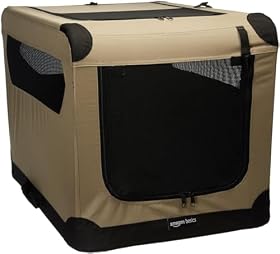
Soft crates are light and easy to pack, while hard crates offer a sturdier shell that is easier to clean. The right choice depends on your dog, the trip, and the carrier’s travel requirements.
Quick answer
Choose a soft crate for a calm, crate-trained dog when low weight and easy storage matter—especially for indoor stays or trips where you carry the crate. Choose a hard crate when you need a rigid, easier-to-clean shell or your dog is more likely to push against the walls. Neither style is automatically safe for car travel or approved for air travel: check the specific carrier’s rules and secure the crate appropriately.
How the two styles compare
Consideration
Soft crate
Hard crate
Weight and storage
Usually lighter and may fold for storage
Bulkier and less convenient to carry
Structure
Fabric panels and mesh can flex
Rigid shell keeps its shape
Cleaning
Fabric may take longer to dry or be harder to clean
Smooth surfaces are generally easier to wipe down
Dog behavior
Best for dogs that settle and do not chew, scratch, or push at the panels
Often a better fit for dogs that need firmer boundaries, though a determined dog may still escape or damage it
Travel requirements
May suit some cabin or indoor uses, but dimensions and rules vary
May be required for some transport situations, but a hard shell alone does not make it airline-approved or crash-safe
Product prices and availability are accurate as of the date/time indicated and are subject to change. Any price and availability information displayed on Amazon.com at the time of purchase will apply to the purchase of this product.
Choose a soft crate when portability matters
A soft crate can be convenient for hotel rooms, visits, events, and other trips where you need a temporary enclosed space. It is often easier to carry and store than a rigid kennel.
It is usually a poor choice for a dog that chews fabric, claws at mesh, or has not learned to relax in a crate. A damaged panel or zipper can let a dog out, so supervise initial use and follow the manufacturer’s instructions. Soft crates are also not a substitute for a secure vehicle restraint.
For a flight, do not assume a soft crate is acceptable just because it can compress. Airlines set their own requirements, including permitted dimensions and whether the carrier must fit beneath a seat. Confirm the rules for your exact route and carrier before buying or traveling.
Product prices and availability are accurate as of the date/time indicated and are subject to change. Any price and availability information displayed on Amazon.com at the time of purchase will apply to the purchase of this product.
Choose a hard crate when you need a rigid shell
A hard crate is easier to wipe clean and can be a practical choice for messy trips or a dog that benefits from a more defined enclosure. Its rigid walls also make it easier to stack or handle in some settings, depending on the crate’s design and the transport provider’s rules.
Hard crates can be heavy and awkward to carry. Check that the door latches securely and that the assembled crate is stable. A standard hard-sided kennel is not automatically crash-tested; do not treat its shell as proof that it will protect a dog in a collision.
For air travel, verify the airline’s current requirements for the specific type of travel. Some trips require a particular kennel construction and setup; a hard shell by itself does not guarantee acceptance.
Make the choice by trip type
Car trips
Use a crate or restraint designed for the way you travel, and secure it according to its manufacturer’s instructions. If crash protection is a priority, look for clear crash-test information for the specific product and vehicle setup rather than relying on the words “hard crate.” Keep the crate away from an active airbag, and never leave a dog loose in the passenger area.
Flights
Check the airline’s rules before choosing a crate. Cabin and cargo travel can have different requirements, and rules can vary by airline, route, and aircraft. Confirm allowed dimensions, construction, and any other required features directly with the carrier; do not rely only on a retailer’s “airline approved” description.
Hotels and visits
A soft crate is often easier to transport if your dog is comfortable in one and the place you are visiting allows it. A hard crate may be more practical if easy cleanup and a sturdier structure matter more than portability. Confirm any lodging rules before you go.
Check fit and prepare before leaving
Whichever style you choose, follow the crate maker’s sizing guidance. Your dog should have room to stand naturally, turn around, and lie down comfortably. Measure your dog and compare those measurements with the manufacturer’s instructions rather than choosing by weight alone.
Let your dog get used to the crate at home before a long trip. Check zippers, latches, seams, and panels for damage, and make sure the crate is assembled and secured as instructed. If your dog tries to escape or becomes distressed, stop and work on crate acclimation before relying on it during travel.
If the crate is damaged, no longer latches securely, or is the wrong size, replace it before traveling. For a dog that can break out of a soft crate, a more suitable enclosure and gradual training are safer than relying on a stronger-looking fabric model.
FAQ
Is a soft crate or hard crate safer in a car?
Neither style is automatically safe in a crash. Secure the crate as its manufacturer directs, and look for crash-test information for the specific product and setup if crash protection is a priority. A hard shell alone is not proof of crash safety.
Can I use a soft crate on an airplane?
Possibly, but it depends on the airline, route, and whether the dog is traveling in the cabin or cargo. Check the carrier’s current rules for dimensions and construction before purchasing or traveling.
Are hard dog crates airline approved?
Not automatically. A hard shell does not guarantee that a crate meets an airline’s requirements. Confirm the current requirements directly with the airline for your specific trip.
Which crate is better for a dog that chews or scratches?
A soft crate is usually not a good fit for a dog that chews, scratches, or pushes at fabric and mesh. Consider a suitably sized, secure crate and help the dog become comfortable using it before travel.