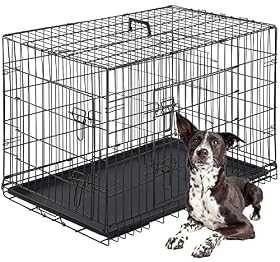
Most adult Labradors need a 42-inch crate, but your dog’s measurements and build matter more than breed alone. Learn how to choose the right size and use a divider for a puppy.
What do you need help with?
Open an answer, or tell us what we should cover next.
Answered in this guide
Choose the right crate size for my Labrador
A 42-inch crate is a common starting point for an adult Labrador, but the final choice should give your dog room to stand naturally, turn around, lie down, and stretch comfortably.
A 36-inch crate may suit a smaller Lab, 42 inches fits many average adults, and 48 inches may suit an unusually large or long-bodied dog when the interior remains practical.
Observe your dog inside the crate and check whether it can stand naturally, turn around easily, and lie fully on its side. If not, reassess the usable space and crate size.
Requests help us prioritize the next guide. No email required.
One anonymous request per topic.
Most adult Labradors need a 42-inch dog crate, but the right choice depends on your dog’s actual length, height, and build. A crate should let your Labrador stand up without crouching, turn around easily, lie down fully, and stretch out comfortably—but it should not be so large that the dog can use one end as a bathroom.
The usual crate size for a Labrador
A 42-inch crate is the most common starting point for a full-grown Labrador. It generally offers enough interior length for an average adult Lab while remaining easier to place in a home than a larger crate.
A 36-inch crate may work for a smaller or more compact Labrador, but it can be too short or narrow for many adult dogs. A 48-inch crate may be appropriate for an unusually large, long-bodied, or very tall Labrador, provided the crate is not oversized for the dog’s needs.
Crate dimensions vary by manufacturer, so use the interior measurements—not only the advertised crate length—when comparing options.
How to measure your Labrador for a crate
Measure your dog while standing naturally. Do not measure from a sitting position.
Measure length
Measure from the tip of the nose to the base of the tail. Do not include the tail itself. Add a few inches for comfortable movement and stretching.
Measure height
Measure from the floor to the top of the head or the highest point of the ears, whichever is taller. Add a few inches so your dog can stand without touching the roof.
Check the usable interior space
Compare your measurements with the crate’s interior dimensions. The crate should allow your Labrador to:
Stand upright without ducking
Turn around without squeezing against the sides
Lie down on their side with legs extended
Sit or change position comfortably
A crate pad, thick bed, or raised floor can reduce the usable height and length. Account for those items when checking the fit.
Product prices and availability are accurate as of the date/time indicated and are subject to change. Any price and availability information displayed on Amazon.com at the time of purchase will apply to the purchase of this product.
Choosing a crate for a Labrador puppy
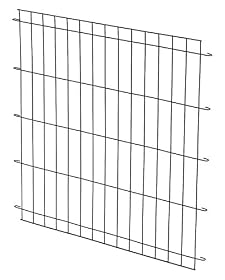
If you are buying for a Labrador puppy, an adult-size crate with a movable divider is usually more practical than buying several crates as the dog grows. Start with the divider positioned so the puppy has enough room to stand, turn around, lie down, and stretch—but not enough extra space to create a separate bathroom area.
Move the divider as the puppy grows. Remove it when the dog can use the full crate comfortably.
A divider is not a substitute for regular bathroom breaks. Young puppies may still have accidents even when the crate is correctly sized.
Product prices and availability are accurate as of the date/time indicated and are subject to change. Any price and availability information displayed on Amazon.com at the time of purchase will apply to the purchase of this product.
When to choose a 36-, 42-, or 48-inch crate
Choose a 36-inch crate when
Your Labrador is unusually small or compact
The interior measurements fit your dog with room to stand, turn, lie down, and stretch
Your dog is a puppy and you will use a suitable divider
Do not choose a 36-inch crate solely to save space if your adult dog cannot stretch out comfortably.
Choose a 42-inch crate when
You have an average-size adult Labrador
Your dog’s measured length and height fit the interior dimensions
You want a common size with plenty of compatible accessories
For many Labrador households, this is the best first size to compare.
Choose a 48-inch crate when
Your Labrador is especially tall or long-bodied
A 42-inch crate leaves too little room for comfortable stretching
The dog needs extra interior length for its normal sleeping position
A larger crate is not automatically better. If the crate is much bigger than necessary, it may take up more room, be harder to transport, and make house-training less straightforward for a puppy.
Product prices and availability are accurate as of the date/time indicated and are subject to change. Any price and availability information displayed on Amazon.com at the time of purchase will apply to the purchase of this product.
Which crate style works well for a Labrador?
The best style depends on where and how you will use it.
Wire crates: Provide ventilation and visibility, and commonly accept dividers and removable trays. They are a practical choice for home use.
Plastic kennel crates: Offer more enclosed sides and can be useful for travel, but ventilation and interior dimensions should be checked carefully.
Heavy-duty crates: May suit dogs that damage lighter crates or repeatedly try to escape. They are heavier and should be selected for construction quality, not just appearance.
Soft-sided crates: Are portable but generally better for calm, crate-trained dogs that will not chew, push, or claw at the enclosure.
For car travel, follow the vehicle-crate and restraint guidance from the crate manufacturer and your vehicle manufacturer. A crate that works well in the house may not be suitable for transporting a dog in a vehicle.
Common sizing mistakes
Choosing by breed alone
Labradors vary in height, length, weight, and body shape. Breed guidelines are useful for narrowing the choices, but measurements should make the final decision.
Measuring the outside of the crate
Exterior dimensions can include the frame, feet, handles, and door hardware. Check the listed interior length, width, and height when available.
Forgetting the door opening
A crate may have a large interior but a relatively small door. Make sure your Labrador can enter without ducking or squeezing through.
Adding a thick bed after measuring
A deep pad can take away several inches of usable space. Recheck the fit with the bedding installed.
Buying a puppy crate without a divider
An adult-size crate without a divider may give a puppy too much unused space. If the crate will be used during growth, a properly fitted divider can make the larger crate more practical.
What to do if your Labrador seems cramped
Observe your dog inside the crate rather than relying only on weight or breed estimates. If the dog cannot stand naturally, turn around easily, or lie fully on its side, check the following:
Remove bulky bedding temporarily and reassess the actual crate space.
Confirm that the divider is not positioned too far forward.
Measure your dog again while standing naturally.
Compare those measurements with the crate’s interior dimensions.
Replace the crate with a longer or taller model if the fit remains tight.
If your Labrador has enough room but avoids the crate, the issue may be training, noise, heat, location, bedding, or a negative past experience rather than crate size. Never force a dog into a crate or use it as punishment. For persistent distress, consult a qualified veterinarian or certified behavior professional.
Bottom line
For many adult Labradors, start by comparing 42-inch crates. Choose a smaller or larger crate only after checking your dog’s measurements and the crate’s usable interior space. For a puppy, an adult-size crate with an adjustable divider usually provides the most flexibility as the dog grows.
FAQ
Is a 42-inch crate big enough for a Labrador?
A 42-inch crate is large enough for many adult Labradors, but not every Lab has the same build. Confirm that the interior lets your dog stand, turn around, lie down fully, and stretch comfortably.
Can a Labrador use a 36-inch crate?
Some smaller or compact Labradors may fit a 36-inch crate, but many adult Labs need more length. Use your dog’s measurements and the crate’s interior dimensions rather than choosing by breed or weight alone.
Should I get a 42- or 48-inch crate for my Labrador?
Choose a 42-inch crate if it provides enough usable space for your dog. Choose a 48-inch crate when your Labrador is unusually tall or long-bodied and cannot stretch comfortably in the smaller size.
What crate size should I get for a Labrador puppy?
An adult-size crate with a movable divider is usually the most practical option. Adjust the divider so the puppy has room to stand, turn, lie down, and stretch without excessive unused space.
How much extra room should a Labrador have in a crate?
The crate should provide enough room for normal movements and stretching, with only a modest amount of extra space. Excess room is unnecessary and can make house-training more difficult for a puppy.