42 Inch Versus 48 Inch Dog Crate: Which Size Is Better?
A 42-inch crate is often the better fit for a large dog that prefers a cozier den, while a 48-inch crate provides more room for very large dogs or dogs that need extra space. The right choice depends on your dog’s measurements, sleeping style, and available floor space—not breed labels alone.
What do you need help with?
Open an answer, or tell us what we should cover next.
Answered in this guide
Decide whether a 48-inch crate gives needed extra room
Choose a 48-inch crate when your dog needs additional length or room beyond a comfortable 42-inch fit, provided the larger crate fits the space where you plan to use it.
Decide whether a 42-inch crate fits your dog and home
Choose a 42-inch crate when your dog meets the interior length and height requirements with room to move, while its more compact footprint works better for the available space in your home.
Measure your dog while standing naturally with a soft tape measure or string. Use those measurements to check whether the crate provides enough interior height and length for comfortable movement.
For a puppy, consider whether an adult-size crate with a divider is more practical than giving the puppy extra unused space. The choice depends on growth, usable space, and how the crate will be managed.
Request a topic and help us choose what to build next.
Choose the right crate size for a specific breed
Check whether a damaged crate is safe for car travel
Calculate the exact floor space a 42-inch crate needsRead this guide →
Requests help us prioritize the next guide. No email required.
One anonymous request per topic.
A 42-inch crate is usually the better choice when your dog can stand, turn around, lie down, and stretch comfortably without excess unused space. Choose a 48-inch crate when your dog is exceptionally long or tall, needs more room to reposition, or will spend extended periods in the crate. Measure your dog and compare those measurements with the crate’s usable interior dimensions before deciding.
42-inch versus 48-inch dog crate at a glance
Consideration
42-inch crate
48-inch crate
Best for
Large dogs that fit comfortably in a more compact space
Very large dogs or dogs that need additional length and room
Main advantage
Easier to fit in a room and less likely to feel unnecessarily spacious
More interior room for long-bodied or tall dogs
Main drawback
May be too short or narrow for some large dogs
Takes up more floor space and can be excessive for a smaller dog
Puppy use
Often practical with a correctly positioned divider
Useful for a puppy expected to become very large, provided the crate has a secure divider
Key buying check
Interior length, width, and height
Interior length, width, and height—not just the 48-inch label
The inch number generally refers to the crate’s approximate length, but manufacturers do not all use identical outside dimensions or interior layouts. A crate labeled 42 inches may have different usable space from another 42-inch model. Treat the size label as a starting point, not a guarantee.
Measure your dog before choosing
Measure your dog while standing naturally. Use a soft tape measure or a piece of string and then measure the string with a ruler.
Length: Measure from the tip of the nose to the base of the tail. Do not include the full tail length.
Height: Measure from the floor to the top of the head or highest point of the ears, whichever is higher when your dog is standing naturally.
Add movement room: The crate should allow your dog to stand without crouching, turn around without squeezing, lie down comfortably, and stretch or change positions.
Compare those measurements with the manufacturer’s stated interior dimensions. Exterior measurements can include the frame, door, hinges, roof, and other hardware that reduce the space your dog actually uses.
A dog that barely fits a 42-inch crate may be more comfortable in a 48-inch model, especially if it is long-bodied, tall, elderly, stiff, or prone to changing sleeping positions. On the other hand, a smaller dog may feel less secure in a much larger crate and may use one end as a sleeping area and the other as a bathroom.
Product prices and availability are accurate as of the date/time indicated and are subject to change. Any price and availability information displayed on Amazon.com at the time of purchase will apply to the purchase of this product.
When a 42-inch crate makes more sense
Choose the 42-inch size when:
Your dog meets the interior length and height requirements with room to move.
You want to preserve floor space in a bedroom, living room, or vehicle area.
Your dog settles better in a closer, den-like space.
You are using a divider for a growing puppy and the crate can be adjusted as the puppy grows.
A 48-inch crate would leave a large amount of unused space.
The 42-inch option can also be easier to move, clean, and place under furniture-adjacent areas, although the actual weight depends on the crate’s construction. A heavy-duty metal crate, furniture-style crate, and collapsible wire crate of the same nominal length may handle very differently.
Product prices and availability are accurate as of the date/time indicated and are subject to change. Any price and availability information displayed on Amazon.com at the time of purchase will apply to the purchase of this product.
When a 48-inch crate makes more sense
A 48-inch crate is worth considering when:
Your dog cannot stand upright or stretch comfortably in a 42-inch crate.
Your dog is unusually long, tall, or broad for its general size category.
Your dog has limited mobility and needs more room to reposition.
The crate will be used as an open resting area rather than only for short confinement.
You have enough floor space for the crate, door swing, cleaning access, and normal household traffic.
More space is not automatically better. A 48-inch crate can be difficult to place in a small room, and its extra length may not help if the crate is still too low or narrow. Check all three interior dimensions.
Product prices and availability are accurate as of the date/time indicated and are subject to change. Any price and availability information displayed on Amazon.com at the time of purchase will apply to the purchase of this product.
Do breed recommendations settle the question?
No. Breed charts can provide a rough starting point, but individual dogs within the same breed can differ substantially in height, body length, weight, and sleeping habits. Mixed-breed dogs are especially difficult to size from breed labels alone.
Use the dog’s measurements and behavior as the deciding factors. If your dog is between sizes, consider the larger crate only if its width and height are also appropriate and you can manage the additional footprint.
Puppy sizing: divider versus extra space
For a puppy, a full-size crate can be economical if it includes a secure divider designed for that crate. The divider should reduce the usable area enough that the puppy can sleep comfortably without having a separate bathroom corner. Move the divider as the puppy grows.
Do not rely on a loose homemade barrier that the puppy can push over, chew, or climb. Follow the crate manufacturer’s instructions for divider placement and safe use.
A 48-inch crate with a divider may be sensible for a puppy expected to become very large, but only if the finished crate will fit the adult dog. For a dog expected to remain within the typical range for a 42-inch crate, the larger crate may add cost and bulk without adding useful comfort.
Check the room, not just the dog
Before buying either size, mark the crate’s full exterior footprint on the floor with painter’s tape or cardboard. Include space for:
Opening the door fully
Removing the tray or cleaning around the crate
Walking around the crate safely
Placing a water bowl if appropriate for your setup
Adding a pad without making the interior too cramped
Folding or moving the crate, if that feature matters
Also check the door location. A 48-inch crate may technically fit but still be awkward if the door opens into a wall, hallway, or furniture. If the crate will be transported, measure the vehicle opening and consider the crate’s folded or assembled dimensions.
Construction can matter as much as length
Two crates with the same nominal length may differ in practical usefulness because of their design.
Wire crates
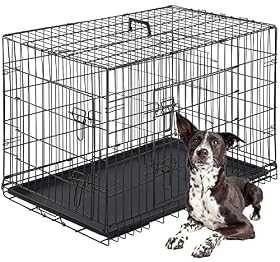
Wire crates commonly offer ventilation, visibility, and a removable tray. They may also fold for storage. Check whether the crate includes a divider, how the door latches, and whether the tray is easy to remove without disturbing the dog.
Plastic crates
Plastic crates can provide more visual enclosure and may be useful for travel, but the interior shape can taper or have less usable width near the top. Compare the interior dimensions rather than assuming the full outside length is available.
Heavy-duty crates
Heavy-duty models may suit dogs that bend, chew, or push against ordinary crate doors, but they can be substantially heavier and harder to relocate. The door, latch, ventilation, and escape resistance matter more than the length label alone. Follow the manufacturer’s safety guidance, especially for dogs that panic when confined.
Furniture-style crates
Furniture-style crates may blend into a living area, but decorative panels can reduce ventilation or usable space. Confirm that the interior is large enough and that the construction is appropriate for your dog’s behavior before prioritizing appearance.
Common sizing mistakes
Choosing by weight alone: Weight does not show whether a dog is especially tall or long.
Measuring only nose to tail tip: The full tail is not normally included in the length calculation, but the dog still needs room to change positions.
Using exterior measurements: Frames and hardware can take up several inches of usable room.
Ignoring height: A crate can be long enough but too low for the dog to stand naturally.
Buying the biggest crate available: Excess space can make a crate harder to place and may reduce the secure, den-like feel many dogs prefer.
Forgetting the pad: A thick crate pad reduces the interior height and floor area available to the dog.
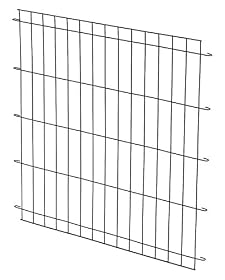
Assuming every divider fits: Dividers are generally designed for specific crate models or dimensions. Verify compatibility before purchasing.
Practical recommendation
Choose the 42-inch crate if your dog can stand, turn, lie down, and stretch comfortably inside its measured interior, and the smaller footprint fits your home better.
Choose the 48-inch crate if the 42-inch option is borderline, your dog is unusually long or tall, or your dog needs extra room for comfortable repositioning. If the dog is still growing, a properly secured manufacturer-matched divider can make the larger crate practical.
When the choice is close, prioritize the dog’s standing height and lying length first, then confirm the crate’s width, door placement, tray, ventilation, and available floor space. If neither size allows natural movement, move to a different crate design or size rather than relying on a cramped fit.
FAQ
Is a 42-inch or 48-inch crate better for a large dog?
Neither is automatically better. A 42-inch crate is suitable if the dog can stand, turn, lie down, and stretch comfortably inside it. Choose 48 inches when the dog is too long or tall for the smaller crate or needs more room to reposition.
What dogs usually need a 48-inch crate?
Very large, tall, or long-bodied dogs may need a 48-inch crate, but breed labels are only rough guides. Measure the individual dog and compare those measurements with the crate’s interior dimensions.
Can a puppy use a 48-inch crate?
Yes, if the crate has a secure, compatible divider that limits the puppy’s usable space. Adjust the divider as the puppy grows, and follow the manufacturer’s instructions.
Should I buy the bigger crate if my dog is between sizes?
Usually choose the larger size if the smaller crate would restrict standing, turning, lying down, or stretching. Make sure the larger crate is not too tall or wide for the dog and that it fits safely in your home.
Does a 48-inch crate need a thicker or larger crate pad?
It needs a pad that fits the crate’s interior floor without bunching or blocking the dog’s movement. Check the pad’s actual dimensions and thickness, since a thick pad reduces usable interior space.