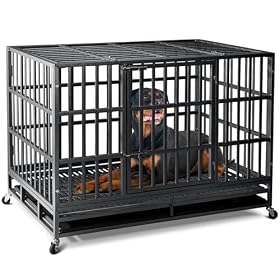
Bolt-on casters can make a large dog crate easier to move, but the right setup depends on the crate frame, total weight, mounting points, and how securely the wheels lock. Use this guide to check compatibility before drilling or buying.
A 48-inch dog crate can be difficult to move once it contains a large dog, crate pad, tray, and supplies. Bolt-on casters may help, but they are only appropriate when the crate has a strong, suitable frame for mounting. Before buying, confirm the caster plate or bolt pattern fits the crate, calculate the fully loaded weight, and make sure the wheels can lock securely.
Check whether your crate can accept bolt-on casters
Many wire dog crates are designed to sit directly on the floor. They may not have reinforced mounting points, a flat base, or enough clearance for a caster plate. Drilling through thin wire panels or a plastic tray is usually not a secure way to attach wheels.
Look at the bottom of the crate for:
A rigid metal perimeter frame or base that can support hardware
Flat mounting areas for caster plates or brackets
Existing holes, threaded inserts, or manufacturer-approved wheel attachments
Enough clearance for wheels, mounting plates, and the crate tray
A design that will not become unstable when raised off the floor
If the crate has no strong mounting location, a rolling platform or purpose-built crate dolly is generally safer than attaching casters directly to the wire. Check the crate manufacturer’s instructions before modifying it. Drilling or welding can weaken the frame and may void a warranty.
Choose casters based on the loaded weight
Do not size the casters for the empty crate. Include the dog, tray, pad, divider, cover, and anything stored on or inside the crate. Then select a set whose combined rated capacity comfortably exceeds that total.
A four-caster set does not always divide the load perfectly. Weight can shift when the dog moves, when the crate crosses a threshold, or when one wheel is on an uneven surface. A margin above the calculated load helps reduce bending, wheel failure, and difficult rolling.
The crate’s center of gravity also matters. A tall crate on small wheels can tip more easily than a low crate on a wide base. Avoid raising the crate higher than necessary.
Product prices and availability are accurate as of the date/time indicated and are subject to change. Any price and availability information displayed on Amazon.com at the time of purchase will apply to the purchase of this product.
Look for the right mounting hardware
Bolt-on casters commonly use a top plate with several bolt holes, but the mounting plate must sit against a strong, flat section of the crate base. Compare these measurements before ordering:
Plate length and width
Hole spacing from center to center
Bolt diameter and length
Available clearance around the crate frame
Wheel diameter and overall caster height
Whether the bolts can be tightened without crushing the frame
Use hardware suitable for the frame material and follow the caster manufacturer’s mounting instructions. If the frame is hollow or thin, simply tightening a bolt may pull through the metal. A qualified fabricator may be able to add reinforcement plates, but do not rely on improvised washers if the base flexes under load.
Avoid bolts that protrude into the crate interior. Any exposed fastener should be covered or positioned outside the dog’s reach, with no sharp edges or threads that could catch a paw, collar, bedding, or tail.
Product prices and availability are accurate as of the date/time indicated and are subject to change. Any price and availability information displayed on Amazon.com at the time of purchase will apply to the purchase of this product.
Decide between swivel and rigid casters
Swivel casters make it easier to turn the crate in tight spaces. Rigid casters track more predictably in a straight line but require more room to change direction. For a large crate inside a home, a combination of swivel and rigid casters may provide a balance of control and maneuverability, provided the mounting arrangement is stable.
Caster height affects more than movement. Taller wheels provide more clearance over thresholds but raise the dog’s crate higher and can increase tipping risk. Lower wheels keep the center of gravity down but may catch on rugs, door transitions, or uneven flooring.
Use locking casters, but do not treat them as a permanent restraint
At least some of the casters should have reliable wheel or total-lock brakes. A wheel brake that stops the wheel from rolling may not prevent the caster from swiveling. A total-lock mechanism is more secure when the crate must remain in one position.
After installation, push the locked crate gently from several directions. It should not roll, twist, rock, or lift one corner. Recheck the fasteners after the first few moves and periodically afterward.
Even locked casters are not a substitute for a fixed crate base when:
The dog pushes hard against the door or sides
The crate is near stairs, a drop-off, or a doorway
The floor slopes
The crate is used in a vehicle
The dog is anxious, strong, or likely to panic
Do not move a crate while the dog is inside unless the crate and caster system are specifically designed for that use and the dog can remain safely contained. Never use ordinary caster wheels as a vehicle restraint.
Protect the floor and improve stability
Hard plastic or metal wheels can mark wood, vinyl, tile, or laminate floors. Soft-tread wheels are usually gentler, but confirm that the wheel material is compatible with the flooring and the crate’s total load. A mat beneath the crate can reduce scratching and help prevent sliding, but it should not interfere with wheel locks.
Check that the crate sits level after installation. If one caster is lower or the frame twists, the door may bind and the tray may no longer fit correctly. Do not compensate for a badly mismatched caster set by stacking loose spacers under the wheels.
For carpet, larger wheels generally roll more easily than small casters, but even large wheels can snag in thick pile. A stationary base or low rolling platform may be more stable than direct-mounted casters on plush carpet.
Installation checklist
Empty the crate and remove the tray.
Measure the crate’s bottom frame and identify the available mounting points.
Estimate the fully loaded weight, including the dog and accessories.
Compare the caster plate, bolt pattern, wheel height, and capacity with the crate.
Confirm that no bolt or bracket will protrude inside the crate.
Install the casters according to the manufacturer’s instructions, using suitable reinforcement if required.
Check that the crate remains square and the door opens normally.
Test rolling and braking with the crate empty.
Add the tray and bedding, then repeat the stability check.
Inspect the hardware regularly for loosening, bent brackets, worn wheels, or damaged locks.
If the crate rocks, the frame bends, the mounting holes tear out, or the wheels do not lock reliably, stop using the caster setup.
When a rolling platform is the better choice
A separate rolling platform is often the better option when the crate has a plastic base, lacks a reinforced frame, or may need to be returned without permanent modifications. It can support the crate from below while keeping bolts and brackets away from the dog.
Choose a platform that supports the crate’s full footprint rather than balancing it on narrow rails. Add a method to keep the crate from sliding, such as a compatible lip or manufacturer-approved attachment, without blocking the door or ventilation.
If the crate is moved only occasionally, lifting it with two adults may be safer than installing permanent wheels. For frequent movement, consider whether a crate designed with an integrated wheeled base is more appropriate than modifying a standard 48-inch model.
FAQ
Can I attach bolt-on casters directly to a wire dog crate?
Only if the crate has a strong, suitable frame and the caster manufacturer’s hardware can be securely mounted without weakening the crate or exposing hardware inside. Do not bolt casters through thin wire, a plastic tray, or unsupported sheet metal.
How much weight should casters for a 48-inch dog crate support?
The combined caster rating should exceed the fully loaded weight of the crate, including the dog, tray, bedding, divider, and stored items. Allow extra capacity because the load shifts when the dog moves or the crate crosses a threshold.
Do all four casters need to lock?
Not always, but the crate should have enough reliable brakes to prevent both rolling and unwanted swiveling. Test the locked crate from several directions. For a strong or restless dog, a fixed base may be safer than relying on caster brakes.
Will casters damage my floor?
They can, especially if the wheels are hard, overloaded, dirty, or dragged sideways. Choose a floor-appropriate wheel material, keep the wheels clean, and use a suitable mat when it will not interfere with stability or the brakes.
What should I do if my crate has no place to mount casters?
Use a properly sized rolling platform, a manufacturer-approved base, or a crate designed with integrated wheels. Avoid improvised attachments that can pull through the crate frame or create sharp edges inside the enclosure.