A covered crate can create a calmer, darker space, while an uncovered crate offers better visibility and airflow. The right choice depends on your dog, home, and crate setup.
A covered crate is not automatically better than an uncovered crate. A cover can give some dogs more privacy and help them settle, while an uncovered crate makes monitoring, ventilation, and cleaning easier. For most homes, the best choice depends on whether your dog relaxes with less visual stimulation or becomes anxious, hot, or destructive when enclosed.
Covered crate versus uncovered crate at a glance
Consideration
Covered crate
Uncovered crate
Privacy
Better; blocks some household activity
Lower; the dog can see more of the room
Airflow
May be reduced if the cover is thick or poorly fitted
Usually more open
Temperature
Can retain more warmth
Usually easier to keep cool
Supervision
Less visibility unless part of the crate remains open
Easier to observe the dog
Cleaning
The cover adds another washable item
Simpler setup
Noise and stimulation
May soften visual distractions, but not loud sounds
The dog can watch and respond to activity
Chewing risk
A loose or reachable cover can become a hazard
Fewer fabric parts to grab
When a covered crate makes sense
A cover may help when your dog has trouble settling because of movement, people walking by, bright lights, or activity in the room. Blocking some of the visual stimulation can make the crate feel more like a quiet resting area.
A cover can also be useful when the crate is in a busy part of the home and you want to create a clearer boundary around nap time. Some dogs rest better when they cannot watch every household movement.
Choose a cover that:
Fits the crate without hanging loosely inside
Leaves adequate ventilation on the sides or back
Does not block the door if the dog could pull it through the bars
Can be removed and washed
Is made from material your dog is unlikely to chew or shred
A cover should support calm behavior, not be used to force a dog to remain quiet or conceal signs of distress. Introduce it gradually by covering only part of the crate at first and observing how your dog responds.
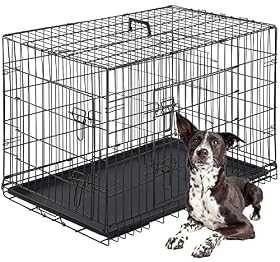
Uncovered crate option with adjustable interior space
Product prices and availability are accurate as of the date/time indicated and are subject to change. Any price and availability information displayed on Amazon.com at the time of purchase will apply to the purchase of this product.
When an uncovered crate is the better choice
An uncovered crate is often the safer starting point for a dog that runs hot, pants heavily, chews fabric, or becomes more distressed when visibility is restricted. It also works well when the crate is already in a quiet location with little visual traffic.
An open setup makes it easier to check your dog’s posture, breathing, and behavior. This is particularly useful during initial crate training, after a move, or when you are trying to understand why the dog is whining, pacing, or refusing to settle.
An uncovered wire crate may also be more practical in warm rooms, during travel stops, or anywhere airflow is a priority. The crate still needs to be placed away from direct sun, heaters, and drafts.
The biggest decision factors
Your dog’s response to visual stimulation
If your dog repeatedly gets up to watch people, barks at passing activity, or struggles to nap in a busy room, partial coverage may help. If your dog becomes more agitated when it cannot see you, leave the crate uncovered or cover only the back and two sides.
Watch for relaxed behavior rather than assuming silence means comfort. A dog that is stiff, panting, drooling, pawing at the cover, or trying to pull fabric through the crate may not be coping well.
Ventilation and temperature
A cover should never turn the crate into a warm, enclosed compartment. Do not cover the entire crate with a heavy blanket, especially in a warm room. Keep air openings clear and check the temperature around the crate rather than relying only on the room thermostat.
Dogs with thick coats, short muzzles, breathing problems, or poor heat tolerance need especially conservative airflow and temperature management. Ask your veterinarian for guidance if heat or breathing is a concern.
Chewing and digging behavior
A fabric cover is a poor match for a dog that grabs, pulls, or chews anything within reach. Loose fabric can be damaged quickly and may create an ingestion or entanglement risk. In that situation, an uncovered crate or a securely fitted cover positioned completely outside the dog’s reach is usually more sensible.
Inspect the cover regularly for frayed seams, holes, loose fasteners, and pulled threads. Remove it immediately if your dog is damaging it.
The crate’s location
A cover cannot fix a poor crate location. First consider whether the crate is near a television, doorway, window, noisy appliance, or high-traffic walkway. Moving the crate to a calmer area may solve the problem without adding a cover.
If the crate is already in a quiet, well-ventilated location, an uncovered setup may provide all the privacy your dog needs.
House-training and messes
An uncovered crate is easier to inspect when a puppy has an accident. Covers can absorb odors and require frequent washing, particularly if they touch a wet tray or floor.
Use a properly fitted crate tray and washable bedding, and keep the cover from dragging on the floor. If accidents continue, reassess crate size, the potty schedule, time left alone, and whether the dog is experiencing stress rather than simply adding more coverage.
How to try a cover safely
Start with the crate uncovered. Make sure your dog can enter, rest, and leave the crate calmly when appropriate.
Cover one section first. The back panel is a practical starting point because it creates some privacy while keeping the front open.
Observe behavior. Look for relaxed posture, normal breathing, and the ability to settle.
Increase coverage slowly if helpful. Stop if your dog paws at the cover, pants, vocalizes more, or tries to escape.
Check airflow and temperature. Keep vents and the door area clear, and avoid direct heat or sunlight.
Secure the cover outside the crate. Do not leave excess fabric where the dog can pull it through the bars.
Wash and inspect it regularly. Follow the care instructions and replace a damaged cover.
Never use a cover to punish barking, conceal panic, or leave a distressed dog unattended. If your dog repeatedly shows panic in the crate, consult a qualified trainer or veterinary behavior professional.
Which setup should you choose?
Choose a covered crate when your dog is calmer with reduced visual stimulation, the room is well ventilated, and your dog does not chew or pull at fabric. Partial coverage is often a better first step than covering every side.
Choose an uncovered crate when you need easy supervision, your dog runs hot, the crate is already in a quiet location, or your dog is likely to chew the cover. It is also the better option while you are still learning how your dog responds to confinement.
When uncertain, start uncovered and add a washable, properly fitted cover gradually. That approach lets you compare your dog’s behavior without committing to a fully enclosed setup.
FAQ
Does covering a dog crate help with anxiety?
It may reduce visual stimulation for some dogs, but it does not treat anxiety by itself. If covering the crate causes panting, pawing, escape attempts, or increased vocalizing, remove the cover and seek help from a qualified trainer or veterinary behavior professional.
Should I cover all four sides of a dog crate?
Usually, no. Leave the door area and ventilation openings clear, and begin with partial coverage. Full coverage can restrict airflow, retain heat, and make supervision harder.
Is a covered crate better for puppies?
Not necessarily. Puppies may benefit from privacy, but they also need close supervision for house-training and may chew fabric. Start with the simplest safe setup and introduce a cover only if the puppy remains calm and cannot reach or damage it.
Can I use a blanket instead of a crate cover?
A blanket can work temporarily if it is securely positioned outside the crate, does not block airflow, and cannot be pulled inside. A properly fitted, washable crate cover is generally easier to secure and inspect.