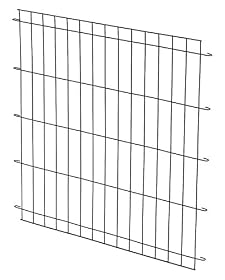
Crate versus an Exercise Pen: Which Is Right for Your Dog?
A crate provides a smaller, enclosed resting and travel space, while an exercise pen gives a dog more room to move. The better choice depends on your dog’s age, training, supervision, and how you use the space.
A dog crate is usually better for sleeping, travel, house-training, and short periods of secure confinement. An exercise pen is better when your dog needs more room to stand, play, stretch, or use a separate bed and potty area under supervision. Many households use both: the crate as the dog’s private den and the pen as a larger controlled area around it.
Usually lighter than a crate but less compact when set up
House-training
Helps establish a sleeping area and routine
Can include separate resting and potty zones, but may provide too much room for some puppies
Escape resistance
Generally more enclosed and secure
Depends heavily on panel height, spacing, and the dog’s climbing ability
Best for unsupervised use
Only for appropriate periods and properly crate-trained dogs
Usually requires more caution because some dogs can climb, push, or chew panels
Travel use
Commonly the better option
Useful mainly for temporary setups at home or at a destination
Choose a crate when you need a secure resting space
A crate is the more practical choice when your priorities are:
Overnight sleeping
Car or air travel, when the crate meets the applicable carrier or transportation requirements
A consistent house-training routine
A quiet retreat away from household activity
Temporary separation from visitors, children, or other pets
Preventing access to unsafe rooms or objects when you cannot provide direct supervision
The crate should be large enough for your dog to stand up, turn around, lie down, and change position normally. It should not be so large that a puppy can comfortably sleep in one end and use the other end as a bathroom. A crate divider can help adjust the usable space as a puppy grows, provided the divider is secure and the dog cannot push around or chew through it.
A crate is not a substitute for exercise, training, or social interaction. Dogs should be given regular opportunities to move, eliminate, and interact with people. Follow your veterinarian’s and trainer’s guidance for your individual dog, especially for puppies, seniors, and dogs with anxiety.
Dog crate for sleeping, travel, and house-training
Product prices and availability are accurate as of the date/time indicated and are subject to change. Any price and availability information displayed on Amazon.com at the time of purchase will apply to the purchase of this product.
Choose an exercise pen when your dog needs more room
An exercise pen can be a better fit for:
Puppies that need a controlled area during supervised daytime activity
Small dogs that need room for a bed, toys, and movement
Dogs recovering from an injury when a larger restricted area is appropriate
Temporary indoor or outdoor containment
Introducing a puppy to a home without giving access to every room
Situations where a crate alone feels too confining for the planned period
A pen can be arranged around a crate, allowing the dog to rest in the crate and move around outside it. It may also accommodate a water bowl, washable mat, or designated potty area. However, adding more space does not automatically make a setup safe for unsupervised use.
Check whether your dog can climb the panels, push the pen across the floor, squeeze through the gaps, or chew the finish. A pen that works for a calm young puppy may not work for a strong, athletic, anxious, or determined adult dog.
Exercise pen for supervised puppy or small-dog space
Product prices and availability are accurate as of the date/time indicated and are subject to change. Any price and availability information displayed on Amazon.com at the time of purchase will apply to the purchase of this product.
Which is better for house-training?
For many puppies, a crate supports house-training because it creates a smaller sleeping area and encourages a predictable schedule of crate time, outdoor potty trips, meals, play, and rest.
An exercise pen can be useful when the puppy cannot be taken outside frequently enough for the planned routine or when a separate indoor potty area is necessary. The tradeoff is that a larger area may make it easier for the puppy to eliminate away from the bed. If indoor potty training is part of your plan, place the potty surface as far as practical from the sleeping and eating areas, clean accidents promptly, and transition gradually as the puppy gains control.
Neither product teaches house-training by itself. Supervision, timing, cleaning, and consistent rewards matter more than the enclosure alone.
Product prices and availability are accurate as of the date/time indicated and are subject to change. Any price and availability information displayed on Amazon.com at the time of purchase will apply to the purchase of this product.
Which is safer when you are away?
Neither a crate nor an exercise pen should be treated as automatically safe for every dog. Before leaving a dog alone, introduce the enclosure gradually and observe how the dog behaves.
A crate may be the safer option for a dog that tries to climb, push, or chew pen panels. A pen may be more appropriate for a dog that becomes distressed in a crate but remains calm in a larger area. Some dogs are unsafe in both types of enclosure when left alone because they panic, chew, or attempt to escape.
Inspect the setup for:
Loose or bent panels
Door latches the dog can open
Gaps that could catch a paw, collar, or jaw
Bedding or toys that can be shredded and swallowed
Water bowls that can tip over
Nearby cords, curtains, furniture, or other climbable surfaces
Remove collars, harnesses, and dangling accessories if they could catch on the enclosure, unless your veterinarian or trainer has given different safety instructions. Always follow the crate or pen manufacturer’s instructions.
Product prices and availability are accurate as of the date/time indicated and are subject to change. Any price and availability information displayed on Amazon.com at the time of purchase will apply to the purchase of this product.
What about size and breed?
Select a crate based on your dog’s actual adult size or expected adult size, not only current weight. A puppy may need a crate with an adjustable divider. Measure the dog while standing and lying down, then compare those measurements with the manufacturer’s interior dimensions. Exterior dimensions can be misleading because walls, corners, and hardware reduce usable space.
For a pen, consider both the floor area and the panel height. A small dog may still need a tall pen if it is an active jumper. Large or athletic dogs may require a more robust enclosure than their weight alone suggests. Pay attention to panel spacing as well as height, particularly for small puppies.
Can you use a crate and exercise pen together?
Yes. A common setup places the crate inside or beside the exercise pen. This gives the dog a defined sleeping space plus room to stand, stretch, and play during supervised periods.
Use the combination carefully:
Secure the crate so it cannot slide or tip when the dog enters and exits.
Make sure the pen cannot be pushed into a wall, furniture, or a dangerous object.
Keep the total area appropriate for the dog’s training and supervision level.
Introduce each item separately before connecting them.
Check the setup whenever your dog grows, gains strength, or develops new behaviors.
A crate-and-pen setup is not necessarily suitable for overnight or unattended use. The dog’s behavior, the construction of the products, and the surrounding room all matter.
Which option is better for common situations?
Overnight sleeping
A properly sized crate is usually the simpler choice for a dog that is comfortable resting there. A pen may work for a dog that needs more room, but it requires careful setup and may complicate house-training.
Car travel
A suitable, properly secured travel crate is generally more appropriate than an exercise pen. Use the vehicle restraint or crate arrangement recommended by the crate manufacturer and transportation authorities.
A new puppy during the day
A pen can provide a controlled area for supervised play, while a crate supports naps and short rest periods. Combining them can work well if the puppy is introduced gradually.
A dog with separation distress
Do not assume that a crate or pen will solve distress. Confinement can worsen panic in some dogs. Consult a veterinarian or qualified behavior professional if your dog vocalizes intensely, injures itself, attempts repeated escape, or cannot settle when confined.
A recovering dog
A crate or pen may be prescribed depending on the injury and the movement restrictions needed. Follow the veterinarian’s instructions rather than choosing based only on the amount of space available.
Common setup mistakes
Buying a crate that is too small for normal movement
Using a crate that is much larger than needed for a puppy’s house-training routine
Assuming a pen is escape-proof because the dog is small
Leaving a dog with a collar, chew, or toy that can become caught or swallowed
Placing the enclosure near cords, blinds, furniture, or unstable objects
Using confinement to replace exercise and training
Increasing confinement time suddenly
Failing to inspect latches, seams, panels, and floor surfaces
Bottom line
Choose a crate when you need a secure sleeping, travel, or house-training space. Choose an exercise pen when your dog needs more room to move during a controlled, supervised period. For many dogs, the most flexible arrangement is a crate paired with a pen—but only after checking that the combined setup is stable, escape-resistant, and appropriate for the dog’s behavior.
If your dog repeatedly escapes, damages the enclosure, or shows signs of panic, stop increasing confinement and seek guidance from a veterinarian or qualified behavior professional. Replace a damaged crate or pen rather than continuing to use one with bent bars, broken latches, sharp edges, or unsafe gaps.
FAQ
Is an exercise pen better than a crate for a puppy?
Not universally. A crate is often better for sleeping, travel, and a structured house-training routine, while an exercise pen gives a puppy more room for supervised daytime activity. Many owners use both.
Can a dog sleep in an exercise pen instead of a crate?
Yes, if the pen is secure, appropriately sized, and the dog settles safely in it. A separate bed or crate inside the pen can provide a defined resting area. Make sure the setup does not allow climbing, chewing, or unsafe gaps.
Can I leave my dog in a crate and exercise pen all day?
Long periods of confinement are not appropriate for every dog. Dogs need exercise, bathroom breaks, interaction, and mental stimulation. Base the schedule on the dog’s age, health, training, and behavior, and ask a veterinarian or qualified trainer for help when needed.
Should the crate be inside the exercise pen?
It can be useful when you want the dog to have a private sleeping area plus additional movement space. Secure both items and supervise the setup first to confirm the dog cannot push, climb, chew, or become caught.