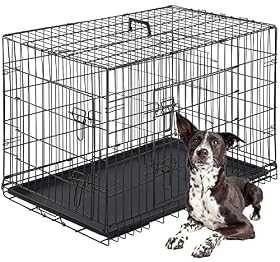
A 36-inch crate is usually the better fit for medium-to-large dogs that prefer a snug sleeping area, while a 42-inch crate gives taller or longer dogs more room. Measure your dog and compare usable interior dimensions before choosing.
A 36-inch dog crate is usually the better choice for a medium-to-large dog that can stand, turn around, lie down, and stretch comfortably inside. A 42-inch crate provides more length and height for larger, taller, or long-bodied dogs—but extra space is not automatically better, especially for puppies still learning to settle or dogs that may use one end as a bathroom.
The right choice depends on your dog’s actual measurements, sleeping position, crate-training stage, and where the crate will sit in your home.
36-inch versus 42-inch dog crate at a glance
Consideration
36-inch crate
42-inch crate
Best for
Medium-to-large dogs with moderate length and height
Larger, taller, or long-bodied dogs needing more interior room
Main advantage
Easier to fit in a room and generally easier to move
More room to stretch, change position, and accommodate a larger dog
Main drawback
May be too short or narrow for some large breeds
Takes up more floor space and can be excessive for a smaller dog
Puppy use
Often useful with a properly positioned divider
Works well if the crate includes a divider or one can be added safely
Travel and storage
Usually more manageable
Bulkier and more difficult to transport
Key warning
A dog may outgrow it in height or length
Too much unused space can complicate house-training
Dimensions vary by manufacturer, so “36-inch” and “42-inch” are crate-length categories rather than guaranteed interior measurements. Always check the product’s usable inside length, width, and height—not only its outside dimensions.
Choose based on your dog's measurements
Measure your dog while standing naturally. You will usually need three measurements:
Length: Measure from the tip of the nose to the base of the tail, then add room for comfortable positioning. Do not measure to the end of the tail.
Height: Measure from the floor to the top of the head or the highest point of the ears, depending on which is higher when your dog is standing naturally.
Width: Consider the dog’s widest point, including the shoulders and any thick coat.
Your dog should be able to:
Stand without crouching or rubbing the crate roof
Turn around without squeezing
Lie down fully on their side
Stretch and change positions comfortably
Enter and exit without ducking excessively
If your dog is between sizes, compare the actual interior dimensions and consider the dog’s body shape. A short, stocky dog may need more width, while a tall or long-bodied dog may need the additional length and height of a 42-inch crate.
Product prices and availability are accurate as of the date/time indicated and are subject to change. Any price and availability information displayed on Amazon.com at the time of purchase will apply to the purchase of this product.
When a 36-inch crate makes more sense
Choose a 36-inch crate when it gives your dog adequate standing height and sleeping length without leaving a large amount of unused space. It is often a practical fit for dogs that are large but not especially tall or long.
A 36-inch crate may also be preferable when:
The crate must fit in a bedroom, office, or smaller living area
You frequently move the crate between rooms
Your dog prefers a more enclosed, den-like space
You want a crate that is easier to transport or store
Your dog is already near adult size and does not need much growth room
Check the interior after adding a crate pad. A thick pad can reduce usable height and floor space, particularly in crates with a low roof or sloped sides.
Product prices and availability are accurate as of the date/time indicated and are subject to change. Any price and availability information displayed on Amazon.com at the time of purchase will apply to the purchase of this product.
When a 42-inch crate makes more sense
A 42-inch crate is worth considering when a 36-inch model would leave little room above your dog’s head or would force the dog to curl up rather than stretch out. It can be a better fit for taller, longer, or larger-framed dogs.
The larger crate may also help if your dog:
Sleeps fully stretched out
Changes positions frequently at night
Has a long back or tall shoulders
Has a heavy coat that reduces the practical space inside
Needs room for a water container or other permitted accessory
A 42-inch crate is not the right choice simply because your dog is labeled a “large breed.” Breed labels are rough guides. Two dogs of the same breed can require different crate sizes based on sex, build, age, and body length.
Product prices and availability are accurate as of the date/time indicated and are subject to change. Any price and availability information displayed on Amazon.com at the time of purchase will apply to the purchase of this product.
Puppy growth: use a divider when possible
For a puppy that will grow into a large adult, a crate with an adjustable divider can prevent the crate from becoming oversized during house-training. Set the divider so the puppy has enough room to stand, turn, lie down, and stretch—but not a large unused section.
Move the divider as the puppy grows. Once the dog needs more room, adjust it gradually rather than buying a second crate solely because the puppy has outgrown the initial section.
A divider is only useful if it is designed for that crate and remains securely attached. Do not use a loose panel, improvised barrier, or accessory that could fall over or create gaps where a dog could become trapped.
Consider the crate's location and construction
The difference between 36 and 42 inches is not only about the dog. Measure the intended location before buying.
Check for:
Doorways and stair turns
Available floor width and depth
Clearance for opening the crate door
Space around the crate for cleaning
Whether the crate must be folded or moved regularly
The location of vents, radiators, or direct sunlight
A 42-inch wire crate may have a substantially larger footprint than its nominal length suggests. A furniture-style or plastic crate may have different interior dimensions and ventilation, so compare usable space rather than assuming all crate types of the same listed length fit the same way.
The door location also matters. A crate that fits the wall but cannot open fully may be impractical. For a dog that enters hesitantly, a wider front opening or a second door may be more useful than a longer crate.
Is a bigger dog crate better?
Not always. The crate should be large enough for normal movement but not so oversized that it becomes difficult for the dog to settle or maintain a clean sleeping area. Some dogs benefit from extra room, while others relax better in a closer, more enclosed space.
Extra space is particularly important to evaluate during puppy house-training. A puppy with access to a large unused area may be more likely to sleep in one section and eliminate in another. A correctly fitted divider can solve this without limiting the dog once it is fully grown.
For an adult dog that is reliably house-trained, additional room is usually less of a concern as long as the crate remains comfortable, secure, and easy to clean.
Which size should you choose?
Choose the 36-inch crate if your dog fits comfortably within its interior measurements, the crate needs to fit a tighter space, or portability matters.
Choose the 42-inch crate if your dog is tall, long-bodied, still growing toward a large adult size, or cannot stand and stretch comfortably in a 36-inch model.
If the dog is still a puppy, prioritize a crate with a compatible divider. If your dog is between sizes, prioritize standing height and sleeping length first, then confirm that the crate will fit the intended room and door path.
When neither size works comfortably, move up or down based on the measurements rather than forcing the dog into a nominal size category. A slightly larger crate with a secure divider is generally more useful for a growing dog than a crate that will be outgrown quickly.
FAQ
What size dog fits a 36-inch crate?
A 36-inch crate often suits medium-to-large dogs, but the correct fit depends on the crate’s interior dimensions and the dog’s measurements. The dog must be able to stand, turn around, lie down fully, and stretch comfortably.
What size dog fits a 42-inch crate?
A 42-inch crate is commonly considered for larger, taller, or longer-bodied dogs. Breed labels are only a starting point, so measure the dog and compare those measurements with the crate’s usable interior space.
Should I buy a 36-inch or 42-inch crate for a puppy?
Choose based on the puppy’s expected adult size and look for a compatible divider. The divider should limit the puppy to a comfortable sleeping area now and be moved as the dog grows.
Can a dog crate be too large?
Yes. A crate with excessive unused space can make settling and house-training more difficult for some dogs. For an adult, reliably house-trained dog, extra room is usually less problematic if the crate remains comfortable and secure.
Do crate pads change the size I need?
They can. A thick pad reduces usable floor space and interior height, so measure or compare the crate after accounting for the pad and any other accessories.