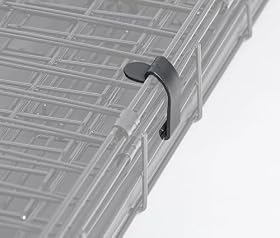
A determined dog can defeat a simple crate latch, but the strongest option depends on how the latch works, how the crate is built, and whether your dog pushes, paws, chews, or manipulates hardware.
Latch types that hold against a determined dog
If your dog paws, noses, chews, or repeatedly throws their weight against a crate door, choose the latch based on the dog's escape method—not just the crate's appearance. A basic wire-crate slide latch may be adequate for many dogs, while a dog that can manipulate hardware may need a more enclosed latch, multiple locking points, or a sturdier crate design.
The latch is only one part of the security system. Door alignment, hinge strength, bar spacing, frame rigidity, and the condition of the tray and crate panels also affect whether a dog can get out.
Common dog crate latch types
Slide-bolt latches
A slide bolt moves horizontally through a receiver on the door frame. This is one of the most common latch designs on wire crates.
Advantages:
Simple to operate
Easy to inspect
Usually quick to open in an emergency
Replacement hardware may be available for some crates
Limitations:
An exposed bolt can be easier for a clever dog to manipulate
A loose receiver or misaligned door can reduce engagement
A dog may bend the door or frame even when the bolt itself remains closed
A slide bolt is more suitable when the dog is strong or anxious but does not actively work the latch with their paws or mouth. Check that the bolt passes fully through its receiver when the door is closed.
Rotating or turn-style latches
Rotating latches use a metal bar, hook, or handle that turns into a closed position. Depending on the design, the moving hardware may be less accessible than a simple exposed slide bolt.
Advantages:
Can provide a more enclosed locking action
Often gives the handler a clear open-and-closed position
May be harder to operate accidentally than a loose sliding bolt
Limitations:
The exact design varies widely between crates
A latch that feels secure can still fail if the door frame flexes
Moving parts need to remain aligned and free of damage
Look for a latch that stays fully seated rather than one that merely rests against the frame. If the handle can rotate partway open under pressure, it is not a good match for a dog that actively tests the door.
Locking-pin and multi-point latches
Some sturdier crates use one or more pins that engage the frame, sometimes at multiple points along the door. Multi-point engagement spreads force across the door instead of relying on one small contact area.
Advantages:
More resistance to a dog pushing on one part of the door
Multiple engagement points can help limit door flex
Often better suited to large, strong, or highly persistent dogs
Limitations:
More complicated to open and close
Pins can fail to seat if the door is twisted or the crate is on an uneven surface
Replacement parts may be specific to the crate model
The important detail is not simply the number of pins. They should engage solid, properly aligned parts of the frame, and the door should not visibly bow when the dog pushes against it.
Padlock-compatible latches
Some crates have a latch with a hole or loop for an external lock. This can prevent a dog from manipulating the main release mechanism, but it also adds handling and emergency-access considerations.
Use an external lock only if it is compatible with the crate and does not create a protruding hazard. Keep the key or combination accessible to responsible adults. Do not use a lock that could trap a dog during an emergency or that leaves sharp edges inside or outside the crate.
A lock cannot compensate for a weak door, large gaps, damaged welds, or a crate that is too small. It may also be unnecessary for a dog that does not attempt to open the latch.
Match the latch to the escape behavior
The dog pushes the door
Prioritize a rigid door and frame with secure engagement at more than one point. A stronger latch on a flexible wire door may not solve the problem because the dog can bend the door far enough to disengage or distort the receiver.
The dog paws at the latch
Avoid an easily accessible release that can be pushed or lifted from inside the crate. Consider a latch with a covered release, a more enclosed mechanism, or a design that requires a deliberate two-step action. Observe the dog during supervised crate use before relying on any setup.
The dog chews the latch or door
Look for durable, chew-resistant construction and keep the dog's mouth away from moving hardware as much as the design allows. Do not add improvised wires, zip ties, or sharp metal pieces that could injure the dog. Persistent chewing may indicate fear, distress, or poor crate conditioning rather than a hardware problem alone.
The dog escapes by bending or breaking the crate
Focus on the complete crate, not just the latch. A heavy-duty crate with a rigid frame and appropriately narrow openings may be more suitable than upgrading a light wire crate's latch. The crate must still provide adequate ventilation, room to stand and turn, and safe access.
The dog opens the crate only when alone
Treat this as a possible anxiety or distress issue. A stronger latch may prevent an immediate escape, but it does not address the cause and could increase injury risk if the dog panics. Consult a veterinarian or qualified behavior professional, particularly if the dog is injuring themselves, breaking teeth, or showing severe separation-related distress.
Product prices and availability are accurate as of the date/time indicated and are subject to change. Any price and availability information displayed on Amazon.com at the time of purchase will apply to the purchase of this product.
What to inspect before blaming the latch
Close the door without the dog inside. Confirm that every bolt, pin, hook, or rotating part reaches its intended closed position.
Check door alignment. Lift or press the door gently while closing it. If the latch only works when you force the door into position, the frame may be bent or the crate may be sitting unevenly.
Look for gaps. Inspect the latch side, hinge side, corners, and bottom of the door. A gap that lets the dog reach the hardware is a security concern.
Test for movement. With the crate empty, apply moderate hand pressure to the door. Excessive flex, loose welds, bent bars, or a shifting frame point to a crate problem rather than a simple latch problem.
Inspect the hardware. Replace bent bolts, missing pins, cracked plastic receivers, loose fasteners, or damaged hinges before using the crate.
Check the crate position. A crate on an uneven floor can twist enough to prevent pins or bolts from seating correctly. Place it on a stable, level surface.
Remove anything that can operate the latch. Bedding, toys, or bowls should not give the dog leverage or block the latch from closing.
Do not test an escape-resistant setup by leaving a distressed dog unattended for a long period. Use short, supervised checks and stop if the dog is becoming frantic or attempting to injure themselves.
Product prices and availability are accurate as of the date/time indicated and are subject to change. Any price and availability information displayed on Amazon.com at the time of purchase will apply to the purchase of this product.
When a replacement latch is enough
A replacement latch may be reasonable when the original hardware is bent, worn, missing, or clearly defective, but the door, frame, hinges, and welds remain straight and strong. Use a part made for the exact crate whenever possible. A universal-looking latch may not have the correct dimensions or engagement depth.
Replace the crate instead when the frame is bent, the door no longer sits square, bars or welds are damaged, the latch receiver has pulled away, or the dog can deform the door with normal pushing. Adding a stronger latch to a structurally weak crate can create a false sense of security.
For an especially strong or determined dog, choose a crate based on the entire construction: rigid door and frame, secure hinges, suitable bar spacing or panel openings, and a locking mechanism the dog cannot reach or manipulate. Follow the crate maker's size, weight, assembly, and use instructions.
Bottom line
For an ordinary dog, a properly aligned slide-bolt latch may be sufficient. For a dog that works the hardware, choose a more enclosed or multi-point locking design. For a dog that bends or breaks the crate, upgrade the crate's overall construction rather than relying on an add-on latch. Whatever style you choose, inspect the closed door every time and address anxiety or escape behavior alongside the hardware.
FAQ
What is the most secure latch type for a dog crate?
A multi-point or enclosed locking design is generally more resistant to manipulation and door flex than a basic exposed slide bolt. The crate's frame, hinges, and door strength are equally important.
Can I add a padlock to a dog crate?
Only if the crate is designed to accept one and the lock does not create a sharp or protruding hazard. Make sure responsible adults can open it quickly, and never use a lock as a substitute for a structurally sound crate.
Why does my dog escape even though the latch is closed?
The dog may be bending the door, exploiting a gap, pushing the frame out of alignment, or damaging the hinges or receiver. Inspect the entire door and frame rather than focusing only on the visible latch.
Should I replace the latch or the whole crate?
Replace the latch when the rest of the crate is straight, rigid, and undamaged and the hardware is the only failed part. Replace the crate when the door, frame, hinges, welds, or latch receiver are bent or damaged.