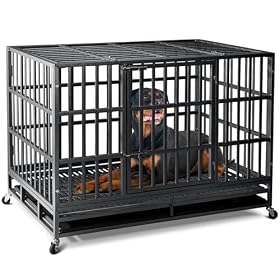
An escape artist needs more than a thicker wire crate. Look for escape-resistant construction, secure latches, safe spacing, correct sizing, and a setup that does not create new hazards.
A heavy-duty crate for an escape artist should be selected for how the dog gets out, not simply by choosing the largest or most expensive-looking crate. Check whether your dog bends wire, opens latches, pushes doors, chews, climbs, or panics. Then choose a crate with stronger construction and a door system that addresses that specific behavior while keeping ventilation and injury prevention in mind.
Start with the escape method
Watch your dog closely—preferably through a camera when you are not home—to identify the failure point:
Pushing or bending panels: Look for rigid steel construction, strong welds, and a frame that does not flex under pressure.
Opening the door: Choose a door with a secure, escape-resistant latch. A simple slide bolt may not be enough for a clever or determined dog.
Chewing: Avoid exposed soft materials, thin wire, and parts the dog can reach through the bars. A metal crate may resist chewing better than fabric or plastic, but it still needs safe interior edges.
Climbing: A tall crate or exposed horizontal bars may give some dogs footholds. Consider the crate’s internal layout and whether your dog can get its paws or muzzle caught.
Panic or repeated impact: A stronger crate alone may not solve the problem. A dog that throws itself at the door can suffer broken teeth, damaged nails, or other injuries even if the crate holds.
If the behavior involves severe panic, self-injury, destructive escape attempts, or separation distress, consult a veterinarian or qualified behavior professional. Do not treat a stronger crate as a substitute for addressing the underlying problem.
Features that matter in a heavy-duty crate
Rigid, durable construction
Prioritize a crate that remains stable when the dog pushes against it. Check the panel joints, corners, door frame, and floor support—not just the material listed in the product description. Welded metal construction can be more resistant to bending than lightweight wire, while reinforced wire crates may be suitable for dogs that are strong but not actively destructive.
Avoid sharp edges, rough welds, exposed fasteners, and openings large enough for a paw, jaw, or collar to become trapped. If you can inspect the crate in person, run a protected hand along accessible edges. For online purchases, review the manufacturer’s dimensions, construction details, and safety guidance carefully.
Secure door hardware
The latch is often the first place an escape artist defeats. Look for a door that closes squarely and a latch that cannot be reached easily from inside. Some crates use multiple locking points or more substantial hardware, but the important question is whether the mechanism stays engaged when the dog pushes, paws, or rattles the door.
A separate padlock or clip should only be used if the manufacturer permits it and the hardware cannot create a snag or pinch hazard. Never add improvised ties, chains, or dangling locks inside the dog’s reach.
Safe bar spacing and openings
Bar spacing should be narrow enough that the dog cannot put its head or jaw through the opening. This is especially important for puppies, narrow-headed dogs, and dogs that repeatedly bite or paw at the crate. Compare the spacing with your dog’s actual head and muzzle size rather than relying only on breed labels.
The dog should not be able to catch a paw, tooth, collar, or toenail in the door or side panels. Remove collars, harnesses, and tags before crating if your veterinarian and trainer agree that this is appropriate; they can catch on crate components during unsupervised periods.
Stable placement
A crate that slides, tips, or rattles can make escape attempts worse. Place it on a level, non-slip surface and leave enough clearance around it for ventilation and access. Do not position it next to furniture, shelves, curtains, cords, or other objects the dog could pull into the crate or use to climb.
If the crate has wheels, use the manufacturer’s wheel locks or remove the wheels when possible. Do not bolt or modify the crate unless the manufacturer specifically allows it, because alterations can weaken the structure or create sharp projections.
Product prices and availability are accurate as of the date/time indicated and are subject to change. Any price and availability information displayed on Amazon.com at the time of purchase will apply to the purchase of this product.
Choose the right size—not the smallest possible crate
The dog should be able to stand naturally, turn around, lie down comfortably, and stretch out. A crate that is too small can increase stress and injury risk. A crate that is excessively large may give an anxious dog more room to build momentum against a door or may allow a puppy to use one end as a bathroom.
Measure the dog while standing and lying down, then compare those measurements with the manufacturer’s interior dimensions. Use interior dimensions rather than exterior dimensions, especially when the crate has thick panels, a divider, or a raised floor.
For a growing puppy, a properly fitted divider can reduce excess space while allowing the crate to expand later. The divider must be firmly secured and have no gaps where the puppy can get its head or limbs caught. Do not use a divider as a restraint for a dog that is actively trying to break through it.
Product prices and availability are accurate as of the date/time indicated and are subject to change. Any price and availability information displayed on Amazon.com at the time of purchase will apply to the purchase of this product.
Heavy-duty crate styles
Reinforced wire crates
These can provide good airflow and visibility and are often easier to fold or move than solid metal crates. They may work for dogs that test doors but do not bend panels, chew metal, or repeatedly slam into the crate. Check the wire gauge, welds, door frame, and latch design rather than assuming any wire crate is escape resistant.
Heavy-gauge metal crates
These are generally worth considering for powerful dogs or dogs that have bent lighter panels. They are usually heavier and less convenient to move. Look for smooth interior surfaces, safe ventilation, sturdy flooring, and a door that cannot be defeated from inside.
Solid plastic crates
Plastic crates can be useful for some dogs and may offer fewer exposed bars to chew. However, they are not automatically escape proof. A strong dog may crack, chew, or push through plastic components, and ventilation must remain adequate. Check the door, hinges, shell, and ventilation openings as a complete system.
Fabric crates
Fabric crates are usually a poor match for a dog that chews, claws, or panics when confined. They may be appropriate for a calm, crate-trained dog under supervision, but fabric alone does not provide the resistance an escape artist needs.
Product prices and availability are accurate as of the date/time indicated and are subject to change. Any price and availability information displayed on Amazon.com at the time of purchase will apply to the purchase of this product.
Set up the crate before leaving the dog alone
Before using a new heavy-duty crate for unsupervised confinement:
Assemble it exactly according to the manufacturer’s instructions.
Check every fastener, hinge, corner, weld, and latch.
Push gently against the door and panels to confirm that nothing shifts or opens.
Remove collars, harnesses, bedding, bowls, and toys that can become entangled or chewed unless they have been specifically shown to be safe for your dog.
Introduce the crate gradually with the door open, using food rewards and calm training.
Practice short closed-door sessions while you remain nearby.
Increase time only when the dog remains relaxed and does not show escalating escape behavior.
Use a camera during initial unsupervised sessions if possible.
A crate cover may help reduce visual stimulation for some dogs, but it can also become a chewing or pulling hazard. Keep the cover outside the dog’s reach unless it is securely fitted and the dog does not try to grab it through the bars.
When a stronger crate is not the right answer
Stop using the crate and seek professional guidance if the dog is breaking teeth, damaging nails, bleeding, panting heavily, drooling excessively, vomiting, collapsing, or repeatedly throwing its body against the door. Also reconsider the setup if the dog shows escalating distress every time the door closes.
A replacement crate is reasonable when the current one has bent panels, cracked plastic, damaged welds, a door that no longer aligns, or a latch that does not fully engage. Replace damaged trays, dividers, and hardware rather than continuing to use them as-is. If the dog defeats multiple crates, focus on veterinary and behavior support as well as containment; simply moving to a heavier model may increase the force involved in an escape attempt.
FAQ
What is the safest crate material for an escape artist?
There is no single safest material for every dog. Strong metal construction is often a better starting point for dogs that bend wire or chew, while safe bar spacing, smooth edges, a secure latch, and stable placement are equally important. A dog that panics or self-injures needs behavior and veterinary guidance in addition to stronger containment.
Should I use a padlock on a heavy-duty dog crate?
Only if the crate manufacturer permits it and the lock cannot create a pinch, snag, or sharp-edge hazard. Choose a crate whose built-in latch is already designed to resist opening from inside, and avoid improvised chains, ties, or hardware within the dog’s reach.
How big should a crate be for a dog that tries to escape?
The dog should be able to stand naturally, turn around, lie down, and stretch out. Do not make the crate uncomfortably small to prevent movement. Compare your dog’s measurements with the crate’s interior dimensions and use a properly secured divider only for a growing puppy.
Can a crate cover stop a dog from escaping?
A cover may reduce visual triggers for some dogs, but it will not fix a weak latch or flexible panels. It can become dangerous if the dog pulls it through the bars or chews it, so use one only when it is securely fitted and the dog does not treat it as a toy.
When should I replace a dog crate?
Replace it when panels are bent, welds or fasteners are damaged, the door no longer aligns, the latch fails to engage completely, or the tray has cracked or warped. If the dog is injuring itself while trying to escape, stop relying on the crate and contact a veterinarian or qualified behavior professional.