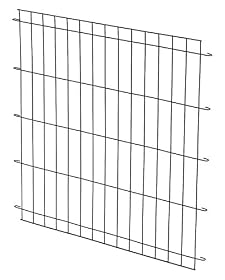
Choose a crate based on your puppy’s expected adult size, then use a divider to create a safe puppy-sized space while your dog grows.
A puppy that will grow usually needs a crate sized for its expected adult dimensions, not a separate crate for every growth stage. Choose a crate that will eventually let your adult dog stand up, turn around, lie down naturally, and stretch out comfortably. Add a properly positioned divider so the crate is not oversized during house training.
Choose the crate by adult size
Estimate how large your puppy will be as an adult using the breed standard, the parents’ size, or guidance from your veterinarian. If your puppy is a mixed breed and the adult size is uncertain, use the best available estimate and plan to adjust as your dog grows.
Measure your dog or estimate the adult measurements for:
Floor-to-top height: from the floor to the tallest point of the head or ears, whichever is higher when the dog is standing naturally.
Nose-to-tail length: from the nose to the base of the tail. Do not include the full tail length.
Body width: the widest part of the body.
The finished crate should provide enough room for the adult dog to:
Stand without crouching
Turn around without squeezing against the sides
Lie down fully, including with legs extended when practical
Sit comfortably without the head or ears pressing against the top
Do not choose a crate only by your puppy’s current weight. Weight ranges vary by breed and body type, while usable interior dimensions determine whether the crate fits.
Use a divider for the puppy stage
A divider is the most practical way to use one growing crate. It reduces the available floor area while your puppy is small, then moves backward as the puppy grows.
The puppy should have enough space to stand, turn around, lie down, and change position. The space should not be so large that the puppy can sleep at one end and routinely use the other end as a bathroom. A divider can support house training, but it does not replace regular potty breaks and supervision.
Move the divider when your puppy begins to look cramped or cannot comfortably stand, turn, or lie down. Check the fit after growth spurts rather than relying only on a calendar schedule.
Use the crate’s interior dimensions
When comparing crates, look for the usable interior dimensions, not just the advertised crate length. Doors, corner curves, molded plastic walls, hardware, and a thick pad can reduce the actual space available to the dog.
A crate pad also takes up some interior height and floor area. Install the pad before deciding where to position the divider, and make sure the remaining space is still comfortable.
Product prices and availability are accurate as of the date/time indicated and are subject to change. Any price and availability information displayed on Amazon.com at the time of purchase will apply to the purchase of this product.
What if the adult size is uncertain?
If you cannot confidently predict your dog’s adult size, avoid buying the smallest crate that might fit. A slightly larger crate with an adjustable divider is generally more adaptable than a crate that your puppy will quickly outgrow.
For a mixed-breed puppy, ask your veterinarian about expected growth and consider the puppy’s current structure, paws, legs, parents, and likely breed mix. Treat these as estimates rather than guarantees. You may eventually need a larger crate if your dog exceeds the expected adult size.
Product prices and availability are accurate as of the date/time indicated and are subject to change. Any price and availability information displayed on Amazon.com at the time of purchase will apply to the purchase of this product.
Crate style affects the fit
Different crate styles can have different usable space and practical limitations:
Wire crates commonly work well with dividers and allow airflow and visibility. Check that the divider locks securely and cannot leave gaps where a puppy could get stuck.
Plastic kennel-style crates can feel more enclosed and are often useful for travel, but their tapered shape may provide less usable space near the floor or top.
Heavy-duty crates may suit dogs that can damage lighter crates, but they can be heavier, less portable, and more difficult to divide. Choose one only if its construction and ventilation are appropriate for your dog.
Soft-sided crates are generally better for calm, crate-trained dogs. They are usually not a good choice for a puppy that chews, scratches, or is still learning to settle.
Whatever style you choose, the door should close securely, ventilation should be adequate, and the crate should not have openings or damaged parts that could catch a collar, paw, or toenail.
Product prices and availability are accurate as of the date/time indicated and are subject to change. Any price and availability information displayed on Amazon.com at the time of purchase will apply to the purchase of this product.
Avoid sizing too small or too large
A crate is too small if your puppy must crouch, cannot turn around normally, or cannot lie down without pressing against the sides. Stop using it at that setting and reposition the divider or move to a larger crate.
A crate may be too large for a puppy in training if it has substantially more space than the dog needs and the puppy repeatedly eliminates inside it. This is not always caused by crate size—illness, stress, an inconsistent schedule, and too much time in the crate can also contribute. Do not restrict space so much that the puppy cannot move comfortably.
Product prices and availability are accurate as of the date/time indicated and are subject to change. Any price and availability information displayed on Amazon.com at the time of purchase will apply to the purchase of this product.
A simple buying process
Estimate your puppy’s adult height and length.
Compare those measurements with the crate’s usable interior dimensions.
Choose a crate that fits the expected adult dog.
Confirm that a compatible divider is included or available.
Add the pad and water setup, if appropriate, before setting the divider.
Recheck the fit after growth spurts.
Replace the crate or divider if it becomes damaged, unstable, or unsafe.
Never use a crate as a punishment or leave a puppy confined longer than it can reasonably manage. Puppies need exercise, interaction, training, and frequent bathroom opportunities outside the crate. Ask a veterinarian or qualified trainer for help if your puppy shows persistent panic, attempts to escape, or injures itself in the crate.
FAQ
Should I buy a crate based on my puppy’s current size?
Usually, no. Choose a crate for your puppy’s expected adult size and use a divider to provide a smaller, comfortable area during growth.
How much room should a puppy have in a crate?
A puppy should be able to stand, turn around, lie down, and change position comfortably. Avoid making the space so large that the puppy can routinely sleep at one end and eliminate at the other.
When should I move the crate divider?
Move it when your puppy cannot comfortably stand, turn around, lie down, or change position. Growth spurts may require frequent checks.
What if I do not know how big my mixed-breed puppy will get?
Use the best available estimate from your veterinarian, the puppy’s parents, and its current structure. A crate with an adjustable divider gives you more flexibility, but you may still need a larger crate if the dog outgrows the estimate.
Can a puppy use a soft-sided crate?
A soft-sided crate can work for a calm, crate-trained dog, but it is usually unsuitable for a puppy that chews, scratches, or tries to escape. Choose a sturdier crate until the puppy is reliable around the enclosure.