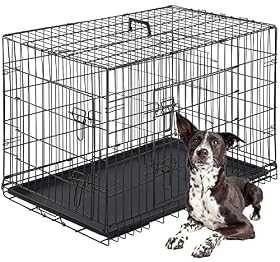
42 inch wire crate with a divider for a growing puppy
A 42-inch wire crate can be a practical long-term choice for a growing puppy, but the listed length is only a starting point. Measure your puppy, check the manufacturer’s interior dimensions, and use a secure divider to create a sleeping area that is large enough to stand, turn around, and lie down comfortably—but not so large that house training becomes harder.
A 42-inch wire crate with a divider can let a growing puppy use one crate from puppyhood into adulthood. The important question is not whether the crate is labeled “42 inch,” but whether its interior dimensions and divider position fit your dog at both stages. Your puppy should be able to stand naturally, turn around, lie down, and stretch out without being forced into an awkward position. The divider should reduce unused space while still leaving enough room for comfortable movement.
Measure your puppy before choosing the crate
Measure your puppy while standing naturally:
Measure from the floor to the top of the head or highest point of the ears, whichever is higher. Add a small amount of growing room.
Measure from the nose to the base of the tail, not including the tail. Add enough room for your dog to turn and stretch out.
Compare those measurements with the crate’s interior dimensions, not just its advertised external length.
A 42-inch crate is not a universal size category. Interior width, height, corner shape, door framing, and the thickness of the tray can vary. Use the crate manufacturer’s sizing chart when available, especially if your puppy is expected to become a large or tall adult dog.
The adult size matters most
Choose a crate that can accommodate your dog’s expected adult size, then use the divider while the puppy is smaller. Breed averages can help estimate adult size, but individual dogs vary. If your puppy’s expected adult height or length is close to the crate’s interior limits, consider the next size category rather than relying on a divider to solve a size problem.
A crate that is too small cannot be made suitable by removing the divider. A crate that is somewhat larger can usually be adjusted safely during growth, provided the divider is secure and the puppy has enough room for comfortable movement.
What to look for in a 42-inch wire crate
A secure, adjustable divider
The divider should attach firmly to the crate and should not be easy for a puppy to push, bend, or pull loose. Check how it connects to the wire panels and whether it can be positioned without leaving a gap where paws, collars, or legs could become caught.
The best divider position creates a sleeping and resting area that is appropriately sized while limiting unnecessary extra space. As your puppy grows, move the divider gradually. Do not use it to confine a puppy so tightly that the dog cannot change position comfortably.
Appropriate wire spacing
Wire spacing should be narrow enough that your puppy cannot push its head through or get a paw trapped. A small puppy may need tighter spacing than an adult dog of the same eventual breed. Look at the actual spacing in the product specifications and photos rather than assuming all 42-inch crates are built the same way.
If your puppy can reach through the wire to grab nearby objects, move the crate away from furniture, cords, curtains, and other hazards. Do not attach accessories that create loops or loose straps inside the crate.
One or two doors
A front door is usually sufficient, but a second side door can make placement easier in a room with limited access. More doors also mean more latches and hardware to inspect. Choose a layout that lets you open the crate without blocking a walkway or forcing the dog to enter from an awkward angle.
Doors should latch securely. If your puppy can manipulate the latch, follow the manufacturer’s guidance for safe use rather than improvising a lock or tying the door shut with a loose cord.
A removable, correctly fitting tray
A plastic or coated tray catches accidents and makes routine cleaning easier. It should sit flat and should not leave a large gap at the edges. A puppy that can reach under the tray may chew it, pull it out, or create an injury risk.
Check replacement-tray availability before buying if the crate will be used for several years. A damaged tray should be replaced rather than covered with loose material that could be chewed or swallowed.
Folding and portability
Many wire crates fold for storage, but folding mechanisms add hinges and connection points. Confirm that the crate locks into its open position and that the panels do not wobble excessively. If the crate will remain in one place, stability and correct sizing matter more than how compactly it folds.
Product prices and availability are accurate as of the date/time indicated and are subject to change. Any price and availability information displayed on Amazon.com at the time of purchase will apply to the purchase of this product.
How to use the divider as your puppy grows
Start with enough space for your puppy to stand, turn, lie down, and stretch. If the area is much larger than necessary, a puppy may use one end as a sleeping space and the other as a bathroom. This is not an absolute rule—accidents can happen during illness, stress, or incomplete house training—but excess space can make training more difficult.
Recheck the fit regularly. Move the divider when your puppy can no longer stand naturally, turn without squeezing around it, or lie down comfortably. Remove the divider when your dog needs the full interior and is ready for that space.
Do not use the crate as a substitute for exercise, supervision, training, or social interaction. Puppies need regular bathroom breaks and age-appropriate activity. Follow your veterinarian’s advice if your puppy has unusual elimination, anxiety, or confinement problems.
Product prices and availability are accurate as of the date/time indicated and are subject to change. Any price and availability information displayed on Amazon.com at the time of purchase will apply to the purchase of this product.
Setup tips for safer everyday use
Place the crate on a level surface away from direct heat, strong drafts, and high-traffic paths.
Keep the crate away from electrical cords, blinds, curtain strings, and objects the puppy can pull through the wire.
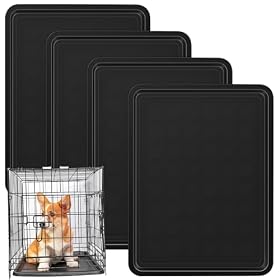
Use a pad only if your puppy does not shred or ingest it. A damaged or chewed pad should be removed.
Attach crate covers so they cannot be pulled through the wire or form loose loops.
Remove collars, harnesses, and dangling tags if they could catch on the crate during unsupervised confinement.
Inspect the wire, welds, door, latch, divider, and tray regularly.
A crate pad is optional. Some puppies are safer and easier to monitor on the bare tray until they stop chewing bedding. If you add bedding, choose a size that lies flat without bunching against the divider or door.
Product prices and availability are accurate as of the date/time indicated and are subject to change. Any price and availability information displayed on Amazon.com at the time of purchase will apply to the purchase of this product.
When a 42-inch crate is the wrong choice
A 42-inch crate may be unsuitable if the adult dog will be too tall or long for its interior, if the wire spacing is too wide for the puppy, or if the crate cannot be divided into a safe starting area. It may also be a poor fit for a dog that panics, repeatedly bends wire, or injures itself trying to escape.
In those cases, do not rely on a stronger improvised latch or additional confinement. Speak with a veterinarian or qualified behavior professional about the dog’s response, and follow the crate manufacturer’s safety instructions. A different crate style, a different size, or a playpen setup may be more appropriate depending on the dog and the situation.
Product prices and availability are accurate as of the date/time indicated and are subject to change. Any price and availability information displayed on Amazon.com at the time of purchase will apply to the purchase of this product.
Bottom line
Choose a 42-inch wire crate with a divider only after comparing its interior dimensions, wire spacing, divider attachment, door layout, and tray fit with your puppy’s expected adult size. The divider should create a comfortable, not cramped, area at each growth stage. If the crate is built securely and adjusted as your puppy grows, it can be a practical long-term training and resting space.
FAQ
What size dog usually fits a 42-inch wire crate?
It depends on the manufacturer’s interior dimensions and the dog’s build. A 42-inch label is not a guarantee of fit, so measure your dog and compare those measurements with the product’s sizing chart. The dog should be able to stand, turn around, lie down, and stretch comfortably.
Is a divider necessary for a puppy?
A divider is useful when the crate is sized for the puppy’s expected adult size but is initially too spacious. It lets you adjust the usable area as the puppy grows. It must be securely attached and positioned so the puppy has adequate room to move.
How much room should a puppy have with a crate divider?
The puppy should have enough room to stand naturally, turn around, lie down, and stretch out. Avoid both extremes: a space that is cramped and uncomfortable or one that is so large that the puppy can easily separate its sleeping and bathroom areas.
Should I put a bed or pad in a wire crate?
Only if the puppy does not chew, shred, or ingest it. A flat, correctly sized pad can add comfort, but removing bedding is safer if the puppy damages it. Never leave loose material, cords, or accessories that could create a chewing or entanglement hazard.
Can a 42-inch crate be used without the divider later?
Yes, if the dog fits the full interior comfortably and the crate remains secure and appropriate for the dog’s behavior. Continue checking the door, wire panels, divider hardware, and tray for damage.