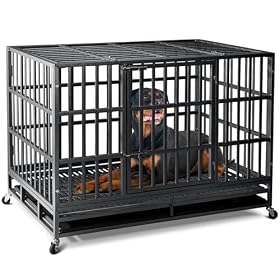
A low-cost wire crate may be perfectly adequate for a calm dog, but price alone does not tell you whether it is safe. Check the crate’s construction, latch, tray, and fit—and consider your dog’s behavior before buying.
Is a cheap wire crate sturdy enough
A cheap wire crate can be sturdy enough for a calm, crate-trained dog that does not push, chew, or try to escape. The important question is not simply how low the price is, but whether the crate stays square, the door latches securely, the wire connections are intact, and the size is appropriate for your dog.
For a dog that panics, bends wire, repeatedly hits the door, or has escaped from crates before, a basic inexpensive wire crate may not be a safe choice. In that situation, look for a more robust crate style and consult your veterinarian or a qualified behavior professional about the underlying anxiety.
What determines whether a cheap wire crate is sturdy enough?
The frame should stay square
Set the crate on a flat surface and inspect it from several angles. The sides and top should align without obvious twisting, bowing, or rocking. A crate that arrives out of square may be difficult to assemble and can put extra stress on the door and latch.
Check the connection points where the panels meet the frame. Loose or poorly aligned sections are more concerning than a plain finish or a lightweight-looking design.
Welds and wire should be intact
Look closely at the welds and wire intersections. Avoid a crate with:
Cracked, incomplete, or sharp welds
Loose wires that move independently
Sharp cut ends or exposed metal edges
Bent panels that do not return to alignment
Coating that is already flaking or peeling
A dog may rub its nose, paw, or teeth against these areas. Small cosmetic imperfections are different from exposed sharp edges or structural gaps.
The door latch matters more than appearance
Open and close the door several times. The latch should engage fully and should not depend on a panel being pulled into position. Check whether the door can be lifted, pushed, or shifted enough to release the latch.
Some dogs learn to manipulate simple slide bolts. If your dog has a history of opening doors or forcing out of crates, choose a crate with a more secure locking design rather than relying on a homemade clip or improvised tie. Never use a setup that could trap a paw, collar, or muzzle.
The tray should fit securely
A removable plastic tray does not usually provide the crate’s main structural strength, but it affects daily safety and usability. Slide the tray into place and check that it sits flat without a large exposed gap.
The tray should not be cracked, sharply warped, or easy for the dog to push out through the door. If the tray is damaged, replace it with a correctly sized replacement rather than letting the dog stand on broken plastic or exposed hardware.
The crate must be the right size
A sturdy crate can still be unsafe or unsuitable if it is too small. Your dog should be able to stand without crouching, turn around, and lie down comfortably in a natural position. Extra space is not always better, especially for puppies still learning house training.
A divider can make a larger crate practical for a growing puppy, provided the divider is secure and does not create sharp edges or openings that could trap a paw.
Product prices and availability are accurate as of the date/time indicated and are subject to change. Any price and availability information displayed on Amazon.com at the time of purchase will apply to the purchase of this product.
When a cheap wire crate is usually adequate
A budget wire crate is often a reasonable choice when your dog is:
Calm and already comfortable in a crate
Not a persistent chewer or escape artist
Appropriately sized for the crate
Supervised during initial use
Using the crate for sleeping, travel, or short periods of rest
Wire crates also provide ventilation and visibility, which many dogs prefer. Their folding design can make them convenient to move or store.
Product prices and availability are accurate as of the date/time indicated and are subject to change. Any price and availability information displayed on Amazon.com at the time of purchase will apply to the purchase of this product.
When a cheap wire crate is a poor choice
Use more caution if your dog has any of these traits:
Repeatedly slams into the door or sides
Bends wire or breaks latches
Chews metal, plastic, or coating
Panics when confined
Has injured its teeth, nails, or paws trying to escape
Is large, powerful, or still growing rapidly
A stronger crate may reduce the chance of escape, but confinement equipment does not solve separation anxiety or panic. If the dog is trying to break out, work on gradual crate training and get professional guidance. Do not leave a dog unattended in a crate that it is actively attempting to destroy.
Product prices and availability are accurate as of the date/time indicated and are subject to change. Any price and availability information displayed on Amazon.com at the time of purchase will apply to the purchase of this product.
How to inspect a cheap wire crate before using it
Do this inspection before putting your dog inside:
Assemble it completely. Confirm that every panel, hinge, connector, and support is in its intended position.
Check for movement. Gently push each side and the top. Minor flex may be normal, but loose joints, rattling hardware, or a frame that shifts out of square are warning signs.
Inspect the door. Confirm that it opens smoothly and that the latch closes fully without excessive force.
Run a cloth over the interior. If it catches on a wire end or weld, do not use the crate until the sharp area is addressed or the crate is replaced.
Install the tray. Make sure it is flat, undamaged, and properly retained.
Check the floor and location. Place the crate on a stable, level surface away from stairs, heat sources, and objects the dog could pull inside.
Supervise the first sessions. Watch for chewing, pawing, pressure on the door, or attempts to lift the latch.
Do not modify structural parts or use makeshift repairs that create entanglement points. Follow the manufacturer’s assembly and weight guidance.
Product prices and availability are accurate as of the date/time indicated and are subject to change. Any price and availability information displayed on Amazon.com at the time of purchase will apply to the purchase of this product.
Is a heavier crate always better?
Not necessarily. A heavier crate may resist movement and bending better, but weight alone does not prove that the welds, latch, or layout are safe. A well-fitting, correctly assembled crate with a secure door is more useful than a heavy crate with poor alignment or an unsuitable design.
For normal home use, focus on construction quality and your dog’s behavior. For a dog that can escape ordinary wire crates, compare sturdier crate types rather than choosing solely by weight or the lowest price.
Bottom line
A cheap wire crate is sturdy enough for many calm, crate-trained dogs if it has a square frame, intact welds, a secure latch, a sound tray, and the correct dimensions. Inspect it before use and supervise your dog’s first sessions. If your dog bends the wire, defeats the latch, or panics in confinement, replace the basic crate with a more suitable setup and address the behavior rather than trying to reinforce a weak crate with improvised hardware.
FAQ
Are inexpensive wire crates safe for dogs?
They can be safe for calm, crate-trained dogs when the frame, welds, latch, and tray are in good condition and the crate is correctly sized. Inspect the crate before use and supervise initial sessions.
How do I know if a wire crate is too flimsy?
Look for a frame that twists or rocks, loose joints, incomplete welds, sharp wire ends, a door that does not latch securely, or a tray that does not fit properly. Any of these can justify choosing a different crate.
Can a dog break out of a wire crate?
A determined or panicked dog may bend wire, defeat a latch, or injure itself while trying to escape. Dogs with this behavior may need a sturdier crate style, gradual crate training, and guidance from a veterinarian or qualified behavior professional.
Should I buy a larger crate for a puppy?
A larger crate can work when it includes a secure divider that limits the puppy to enough room to stand, turn around, and lie down comfortably. Oversizing without a divider can make house training more difficult.