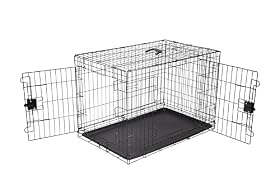
A double-door crate can make a hallway setup more flexible, but only if both doors can open safely without blocking traffic. Use your dog’s measurements, the crate’s exterior dimensions, and the hallway layout to choose the right model.
A double-door crate works well in a hallway because it gives you more placement options: one door can face the main walkway while the other faces a room or wall. The important detail is clearance. Measure the hallway and the intended door-swing areas before buying, then choose a crate that gives your dog enough space without creating a trip hazard or blocking an exit.
Start with your dog’s crate size
Measure your dog while standing naturally:
Length: From the nose to the base of the tail, not including the tail itself.
Height: From the floor to the top of the head or ears, whichever is higher.
Width: At the widest point of the body.
Add enough room for your dog to stand, turn around, lie down, and stretch comfortably. A crate that is too small can be uncomfortable, while one that is excessively large may be less suitable for puppies still being house-trained.
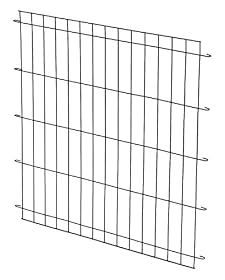
For a puppy, a crate with an adjustable divider can provide more usable space as the dog grows. The divider should create a sleeping area that is large enough for the puppy to move comfortably but not so large that the crate becomes difficult to manage during house-training.
Check the crate’s interior dimensions, not just the advertised dog-size range. The tray, door frame, divider, and interior hardware can reduce the usable area.
Measure the hallway before choosing a crate
Measure at floor level, because baseboards, trim, shoe racks, and furniture can make the usable width smaller than the wall-to-wall measurement.
Check these dimensions:
Available width: The crate should not consume so much of the hallway that people must squeeze past it.
Available length: Account for the crate footprint plus any space needed to open a door.
Door swing: A door needs room to open fully enough for you to reach the dog and remove the tray.
Nearby openings: Keep the crate from blocking bedroom doors, closet doors, stairs, and emergency routes.
Walking clearance: Leave a clear, stable path around the crate whenever possible.
A double-door design does not mean both doors need to be used every day. It gives you flexibility to position the crate with one door facing the most convenient direction. In a narrow hallway, a front-and-side configuration is often more useful than two doors on opposite ends, but the exact layout depends on the crate’s dimensions.
Product prices and availability are accurate as of the date/time indicated and are subject to change. Any price and availability information displayed on Amazon.com at the time of purchase will apply to the purchase of this product.
Choose the door orientation carefully
Before buying, identify which side of the crate will face the hallway and which side will face a room or open area. Then verify that the door locations match that plan.
Look for:
Doors that open without striking a wall or furniture
Secure latches that cannot be easily nudged open
A door opening wide enough for comfortable access
Door hinges and latches that do not create sharp protrusions into the walkway
A removable tray that can be taken out without moving the entire crate
If the hallway is narrow, an inward-opening door would preserve walking space, but most wire crates use doors that swing outward. Do not assume a door can be reversed or re-hung unless the manufacturer specifically allows it.
Product prices and availability are accurate as of the date/time indicated and are subject to change. Any price and availability information displayed on Amazon.com at the time of purchase will apply to the purchase of this product.
Consider the crate style
Wire crates
Wire crates generally provide strong ventilation and visibility, which can suit a hallway where the dog may want to see household activity. They can also be folded or moved more easily than many rigid enclosures, depending on the design.
Potential drawbacks include noise from rattling panels and a more exposed feel for dogs that settle better in a partially covered space. A properly fitted cover can help, but it should not restrict airflow or allow the dog to pull fabric through the bars.
Plastic crates
Plastic crates can provide a more enclosed, den-like environment and may be easier to clean around minor spills. Their solid sides can also reduce visual distractions in a busy hallway.
They may have fewer placement options than wire crates, so confirm the exact door locations and ventilation openings. Make sure the crate does not sit where airflow is blocked by a wall, radiator, or storage item.
Heavy-duty crates
Heavy-duty metal crates may be appropriate for dogs that damage lighter crates, but they can be heavier and less convenient to reposition. Check the construction, latch protection, ventilation, and floor design rather than assuming that extra weight alone makes a crate escape-resistant.
For a dog that repeatedly attempts to break out, injures itself, or shows severe confinement distress, consult a veterinarian or qualified behavior professional. A stronger crate does not solve the underlying safety problem by itself.
Make the hallway placement safer
Place the crate on a level, stable surface where it cannot slide when the dog enters, exits, or shifts position. Avoid placing it directly beside a staircase, heater, radiator, exposed electrical cord, or frequently opened door.
Keep these items out of reach:
Leashes and loose straps that could become entangled
Cleaning chemicals and medications
Small objects that could be swallowed
Charging cables and extension cords
Shoes or clothing the dog may pull through the crate
If the crate sits in a busy passage, consider how people will walk past it at night or while carrying laundry, groceries, or other objects. A crate that fits on paper may still be a poor choice if its corners create a repeated bump or trip point.
Do not place a crate where a swinging door can hit it. If the crate must be near a doorway, check the full range of movement for the door and leave enough room for the dog to enter and exit without being trapped.
Check the tray, divider, and accessories
The tray should slide out in the direction that gives you access without moving the crate or blocking the hallway. If the tray cannot be removed easily, cleaning accidents may become unnecessarily difficult.
A divider is useful for a growing puppy, but it should be securely attached and positioned according to the manufacturer’s instructions. Remove or reposition it as the dog grows rather than allowing the dog to outgrow the available sleeping area.
A crate pad can improve comfort, but choose one that fits without bunching or leaving gaps where paws, nails, or teeth could catch. If your dog chews bedding or has a history of ingesting fabric, use only bedding your veterinarian considers appropriate and supervise the introduction.
A cover can reduce hallway distractions, but keep the ventilation openings clear. Stop using it if your dog pulls it into the crate, chews it, overheats, or becomes more distressed when the crate is covered.
The crate may need to be repositioned as furniture changes
One side must face the hallway and another must face a room
You want easier access for cleaning or handling the dog
The dog is more comfortable entering from a specific direction
A puppy crate will be used with a divider over time
It may not be the best choice if the extra door reduces interior space, adds protruding hardware, or makes the crate too wide for the available hallway. A correctly sized single-door crate is safer than a double-door model that blocks traffic or cannot be opened comfortably.
Buying checklist
Before ordering, confirm:
The dog’s required interior length, width, and height
The crate’s exterior length, width, and height
Which sides contain doors
The direction and clearance required for each door
Whether the tray slides out from the accessible side
Whether a divider is included or compatible
Whether the crate can be secured against sliding
Whether the construction and latch suit the dog’s behavior
Whether the placement leaves doors, stairs, and walkways usable
Whether replacement trays or compatible accessories are available
If the crate cannot fit while preserving a clear, safe hallway path, choose a different location or a smaller footprint—not a crate that limits the dog’s ability to stand, turn, and rest. If no available crate fits both your dog and the hallway safely, a different room or a properly sized exercise pen may be the better solution.
FAQ
Is a double-door crate better for a hallway?
It can be, because the second door gives you more placement and access options. It is only better if the door locations match the hallway layout and opening either door does not block traffic or strike nearby objects.
How much hallway clearance should I leave around a dog crate?
Leave enough space for people to pass without squeezing, tripping, or brushing against the crate. The exact amount depends on the hallway, household traffic, and local safety needs, so measure the clear walking path after accounting for baseboards, furniture, and open doors.
Should the crate door face the hallway or the room?
Face the door toward the area that gives the dog the safest and easiest entry while preserving a clear walking path. If the hallway is busy, facing the door toward a quieter room may reduce distractions, provided you can still reach the dog and remove the tray.
Can I put a crate next to a staircase?
It is usually better to avoid placing a crate where it narrows or blocks a staircase approach. Keep the crate stable, away from the stair edge, and positioned so doors and walking routes remain fully usable.
What should I do if the crate slides in the hallway?
Move it to a level surface, remove anything causing it to rock, and use a manufacturer-approved way to improve stability. Do not permanently alter the crate or block its ventilation and doors. Replace it or relocate it if it remains unstable.