The best dog crate for a puppy is usually one sized for the dog’s expected adult dimensions, with a secure door, good ventilation, and a divider that lets you adjust the living area as your puppy grows.
A good puppy crate should be secure, easy to clean, and large enough for your dog to stand up, turn around, lie down, and stretch comfortably—but not so large that one end becomes a bathroom. For many puppies, the most practical choice is a crate sized for the expected adult dog and fitted with a properly positioned divider.
The right style depends on your home, your puppy’s behavior, and how often you will move or transport the crate.
What to look for in a puppy crate
Size for the adult dog, then use a divider
Measure your puppy’s expected adult height and length using breed guidance, the parents’ size when available, or your veterinarian’s advice. The crate should eventually allow the adult dog to:
Stand without crouching
Turn around normally
Lie down fully stretched or comfortably curled
Change position without pressing against the sides
A crate that is too small is uncomfortable. A crate that is too large can make house training harder because some puppies may use one end as a sleeping area and the other as a toilet.
A divider lets you reduce the usable space while the puppy is small and gradually expand it. The divider should be secure, difficult for the puppy to move, and free of gaps where paws, collars, or jaws could become caught. Remove or reposition it as your puppy grows.
Do not rely on the divider as a substitute for supervision. A puppy should still receive regular bathroom breaks, exercise, training, and social interaction.
Choose a crate style that matches your routine
Wire crates
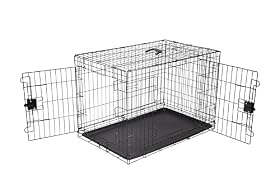
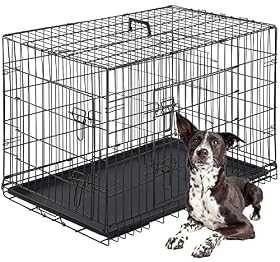
Wire crates are versatile and provide strong airflow and visibility. Many have removable trays and folding designs that make them practical for home use or occasional transport. A wire crate may be a good default if you want to add a cover for quiet time or adjust the interior with a divider.
Check that the wire spacing is appropriate for your puppy. A very small puppy should not be able to push its head through the openings. Look for smooth edges, a stable frame, and a door latch that your puppy cannot easily manipulate.
Plastic airline-style crates
Plastic crates offer more enclosed sides and can be useful for travel, resting, or puppies that settle better with less visual stimulation. They are often easier to carry as a single shell, but ventilation and interior visibility vary by design.
For air travel, requirements are specific and can differ by airline. Confirm the current rules with the airline before buying or traveling. A crate suitable for a car or home is not automatically approved for air transport.
Soft-sided crates
Soft crates are lightweight and convenient for calm, crate-trained dogs. They are usually a poor first choice for a puppy that chews, scratches, or is still learning to settle. Fabric can be damaged quickly, and cleaning accidents may be more difficult.
Consider a soft-sided crate only after your puppy has demonstrated reliable crate behavior and is unlikely to chew the mesh or frame.
Heavy-duty or furniture-style crates
Reinforced crates may suit strong, persistent dogs or homes where escape prevention is a serious concern. Furniture-style crates can blend into a room, but they may be heavier, harder to clean, and less convenient to move.
Avoid choosing a heavy crate solely because it looks secure. The door, hinges, ventilation, floor, and interior surfaces still need to be appropriate for a puppy.
Features that matter most
A secure door and safe latch
The latch should close completely and resist accidental opening. Inspect the door area for pinch points, sharp edges, and gaps. If your puppy can reach the latch, watch whether it paws or mouths the mechanism; a crate that cannot be securely closed is not suitable for unsupervised use.
Double-door designs can make placement easier, especially when one side must face a wall. However, an extra door also means another latch and another area to inspect.
A removable, leak-resistant tray
A removable tray makes accidents easier to clean. Look for a tray that sits securely and does not slide easily when the puppy walks or digs. The tray should not have cracked edges, sharp corners, or openings that could catch toenails.
A tray helps with cleanup but does not eliminate the need to take the puppy outside regularly. If your puppy repeatedly soils the crate, reassess the crate size, bathroom schedule, stress level, and possible medical issues.
Ventilation and visibility
Puppies need adequate airflow. Wire crates provide broad visibility, while plastic crates provide more enclosure. If you use a cover, leave ventilation areas open and make sure the fabric cannot be pulled inside and chewed.
A crate should never be placed where heating vents, radiators, fireplaces, direct sun, or drafts can make the interior dangerously hot or cold.
A divider that fits securely
A divider is particularly useful when buying one crate for a growing dog. It should create a clean, stable partition without leaving spaces that could trap a paw or head. Check the divider regularly as your puppy grows and as the crate hardware wears.
A suitable floor surface
Many crates work best with a thin, washable crate pad or mat that fits without bunching. For puppies that chew bedding or have frequent accidents, begin with a simpler, easily cleaned surface and add softer bedding when the dog can use it safely.
Do not add thick bedding if it causes the puppy to overheat, blocks the door, reduces usable space, or is being shredded and swallowed.
Product prices and availability are accurate as of the date/time indicated and are subject to change. Any price and availability information displayed on Amazon.com at the time of purchase will apply to the purchase of this product.
The best puppy crate for different homes
Best general choice for most homes: a wire crate with a divider
A wire crate with a secure tray and adjustable divider is often the most flexible option. It can grow with the dog, provides ventilation, and works for both short rest periods and routine house training.
It is especially useful when you know the puppy’s expected adult size but do not want to replace the entire crate during growth.
Best for travel or a puppy that settles in an enclosed space: a plastic crate
A plastic crate may be preferable when your puppy relaxes more easily with reduced visual distractions or when you need a crate that is easy to carry as one unit. Confirm that the size, ventilation, and door hardware are suitable for your intended use.
Best for a calm, crate-trained puppy: a soft-sided crate
Soft-sided designs are convenient for travel, events, and temporary use, but they should not be the default for a puppy that is still chewing, scratching, or having accidents.
Best for escape-prone dogs: a reinforced crate selected carefully
If a puppy repeatedly bends wire, opens latches, or damages a crate, address the cause rather than simply increasing confinement. Separation distress, fear, insufficient exercise, and poor crate introduction can all contribute to escape attempts. A stronger crate may reduce escape risk, but it does not treat anxiety or replace professional behavior guidance.
Product prices and availability are accurate as of the date/time indicated and are subject to change. Any price and availability information displayed on Amazon.com at the time of purchase will apply to the purchase of this product.
How to introduce the crate safely
Place the crate in a calm area where the puppy can be near the household without being in constant foot traffic. Introduce it gradually:
Leave the door open and allow the puppy to investigate.
Reward calm behavior near or inside the crate.
Offer meals, chews, or food toys inside when appropriate.
Close the door briefly while you remain nearby.
Increase duration slowly, ending sessions before the puppy becomes distressed.
Continue providing bathroom breaks, exercise, training, and interaction.
Never use the crate as punishment. Do not leave a puppy confined for longer than it can reasonably manage, and follow veterinary or trainer guidance if the puppy shows panic, persistent vocalizing, self-injury, or repeated attempts to escape.
Puppy crate buying checklist
Before choosing a crate, confirm that:
The adult-size dimensions are appropriate for your dog
A divider is included or available if the crate will be used during growth
The latch closes securely
The door and wire spacing cannot trap paws, collars, or heads
The tray is removable and stable
The crate fits the intended room, vehicle, or travel location
The materials can withstand your puppy’s chewing and scratching level
Bedding and accessories will not reduce the usable space too much
The crate can be cleaned after accidents
For a typical household, a well-sized wire crate with a divider is the most adaptable starting point. Choose plastic when enclosure or transport is more important, and reserve soft-sided designs for puppies that are already calm and reliable in a crate. If your puppy is persistently distressed or escaping, consult a qualified trainer or veterinary behavior professional rather than relying only on a more restrictive crate.
FAQ
What size crate should I get for a puppy?
Choose a crate based on your puppy’s expected adult size, then use a secure divider to limit the space while the puppy grows. The usable area should let the puppy stand, turn around, lie down, and stretch comfortably without leaving a large unused section.
Is a wire or plastic crate better for a puppy?
Neither style is best for every puppy. Wire crates offer airflow, visibility, and easy adjustment with a divider. Plastic crates provide more enclosure and can work well for travel or puppies that settle better with fewer visual distractions.
Does a puppy crate need a divider?
A divider is not mandatory, but it is useful when one crate will be used from puppyhood through adulthood. It lets you adjust the living area as the puppy grows and can help prevent an oversized crate from making house training more difficult.
Are soft dog crates safe for puppies?
Soft crates can be safe for calm, crate-trained puppies that do not chew or scratch. They are usually not a good first choice for a puppy still learning to settle because fabric, mesh, and flexible frames can be damaged or swallowed.
How long can a puppy stay in a crate?
The appropriate duration depends on age, bathroom control, health, training, and the individual puppy. Puppies need regular bathroom breaks, exercise, training, and social contact. If a puppy is repeatedly having accidents or showing distress, reduce confinement and seek guidance from a veterinarian or qualified trainer.