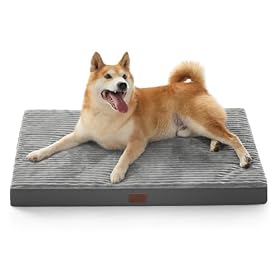
A matching cover and pad can make a crate look finished and feel more comfortable, but the set still needs to fit the crate correctly and suit how your dog uses it.
A matching crate cover and pad set can make a dog crate more comfortable and less distracting, but appearance should come after fit, safety, and cleanability. Before buying, measure the crate’s usable interior, confirm the cover is designed for that crate style, and choose materials that match your dog’s habits—especially chewing, digging, accidents, or overheating.
Start with the crate’s actual measurements
Do not rely only on the crate’s advertised size, such as “medium” or “30-inch.” Those labels vary between manufacturers. Measure the crate and compare the measurements with the pad and cover’s listed dimensions.
For the pad, check:
Length and width: The pad should cover the usable floor without curling up against the door or blocking the crate’s edges.
Thickness: A thicker pad may be more comfortable, but it also reduces interior headroom and can make the crate feel cramped.
Shape: Rectangular pads are common, but some crates have rounded corners or tapered interiors.
Door clearance: Make sure the pad does not bunch up where the door closes.
For the cover, compare the cover’s dimensions with the crate’s outside dimensions. The cover needs to fit over the top and sides without pulling tightly, covering the door improperly, or dragging on the floor.
Allow for the crate’s design
Wire crates, plastic kennels, and furniture-style crates do not use the same type of cover. A wire-crate cover usually attaches around the outside and may include roll-up panels. A plastic kennel may need a cover made for a more enclosed shape, while a furniture-style crate may not need a full cover at all.
If the set is sold for a specific crate model or design, verify compatibility rather than assuming that a similar-looking crate will fit.
Choose the pad for your dog’s habits
The right pad depends more on how your dog behaves than on color coordination.
For calm dogs that sleep in the crate
A soft, washable pad may be suitable if your dog does not chew bedding or pull fabric apart. Look for a surface that can be removed or washed, and check whether the filling can be cleaned if there is an accident.
For puppies or dogs prone to accidents
Prioritize water-resistant or easily washable construction. A removable cover is useful, but it does not necessarily protect the inner cushion. Check whether the entire pad can be washed and dried according to the manufacturer’s instructions.
Keep a spare pad available if the crate is used regularly and the first one needs to be washed.
For chewers and diggers
Loose fabric, zippers, ties, and exposed seams can become problems if your dog chews or digs at bedding. A crate pad is not automatically safe for every dog. Supervise initial use and remove the pad if your dog tears it, pulls out filling, or swallows pieces.
A simpler, more durable pad—or no soft bedding temporarily—may be safer until the behavior is under control. Ask a veterinarian or qualified trainer for help if your dog persistently destroys bedding or shows anxiety in the crate.
Product prices and availability are accurate as of the date/time indicated and are subject to change. Any price and availability information displayed on Amazon.com at the time of purchase will apply to the purchase of this product.
Check the cover’s ventilation and access
A cover should reduce visual stimulation without turning the crate into an overheated or poorly ventilated enclosure. Look for roll-up panels, breathable fabric, and openings that allow air to circulate. Do not use a cover that blocks ventilation openings or traps heat around the crate.
A cover that must be removed completely for every interaction may be inconvenient, particularly during house-training or nighttime use.
Matching colors are useful—but not the main test
Buying a cover and pad together can simplify color matching and may reduce the chance of choosing visibly different fabrics. However, a coordinated set is not necessarily better made or safer than separate pieces.
Compare the set with separate products if the included pad is too thin, the cover is poorly ventilated, or either item is difficult to clean. It is often better to buy a well-fitting cover and a more practical pad separately than to compromise for a matching pattern.
Inspect attachment points and loose parts
Before putting the set into regular use, inspect the cover’s straps, ties, elastic, snaps, and fasteners. They should not hang inside the crate where a dog can grab them. Secure or remove any loose part that could be chewed.
The pad should lie flat and should not slide enough to fold over itself. If the dog can push it into a pile that blocks the door or creates a chewing target, it may not be the right design for that crate.
Never attach a cover in a way that prevents the crate door from closing and latching securely. Follow the cover manufacturer’s instructions, and do not modify the crate or cover near structural supports unless the manufacturer specifically permits it.
Cleaning and maintenance matter more than the first impression
Before buying, check the care instructions for both pieces. Useful features may include:
A removable, machine-washable pad cover
A pad that can be cleaned after accidents
Fabric that does not hold excessive hair
A cover that can be washed without losing its shape
A tray-access design that does not require dismantling the crate
Wash bedding before the first use if the care label allows it. Inspect the pad and cover regularly for torn seams, exposed filling, damaged fasteners, or dampness trapped beneath the pad.
A pad that stays damp against the crate floor can develop odors and may damage some surfaces. Remove and dry the pad promptly after accidents or spills.
A practical buying checklist
Before ordering a matching cover and pad set, confirm:
The pad’s length, width, and thickness suit the crate’s usable interior.
The cover fits the crate’s outside dimensions and style.
The door, latch, handles, tray, and divider remain usable.
The cover provides shade or privacy without blocking airflow.
The pad and cover have care instructions that fit your routine.
The materials are appropriate for your dog’s chewing and digging habits.
No ties, straps, zippers, or filling will be accessible to the dog.
You have a replacement plan if the pad becomes damaged or repeatedly soiled.
When to buy separately instead
Choose separate products when the crate and dog have different needs—for example, a well-ventilated cover for a wire crate paired with a waterproof, highly washable pad. Separate purchases also make sense when your dog’s size is between standard crate dimensions, when the included pad is too thick, or when the cover does not provide convenient door access.
If your dog chews bedding, overheats easily, or shows distress when covered, skip a full matching set and introduce comfort or privacy more cautiously. A cover should never be used to conceal a safety, separation-anxiety, or temperature problem.
FAQ
Should a crate cover and pad be the same size?
The pad should fit the usable interior floor, while the cover should match the crate’s outside dimensions. They do not use the same measurements, so compare each item with the appropriate part of the crate.
Can I use any crate pad with a crate cover?
Usually, but the pad must fit without bunching and the cover must fit the crate style without blocking ventilation, the door, the latch, or the tray. A matching set is convenient but not required.
Is a crate cover safe for every dog?
No. Some dogs chew fabric, pull at fasteners, or become too warm in a covered crate. Supervise initial use, maintain airflow, and remove the cover if your dog damages it or shows signs of overheating or distress.
What should I do if my dog keeps destroying the crate pad?
Remove damaged bedding so the dog cannot swallow fabric or filling. Consider a simpler, more durable option or temporary bedding changes, and consult a veterinarian or qualified trainer if chewing is persistent or connected to crate anxiety.